Project 1 : A changing scene
Aim: Drawing moving figures or a changing scene can be extremely challenging. A large part of that challenge, however, is your own conception of the purpose. By taking a step back from trying to pin the action down to a static conclusion, and instead making a drawing which is a record of the movement and action itself, we can begin to reflect on how to balance movement and form to create a dynamic image.
Method: Find a fairly busy scene, with plenty of movement. Sit somewhere comfortable and out of the way and start making a drawing. As something catches your eye, capture it as best you can. Keep responding to movements as they happen so you build up a drawing full of dynamic energy. Depending on how fast you can capture form or how much repetition your view has, you may be able to build up a convincing representation of the scene. Whatever happens, you should be able to make a drawing which captures a sense of time elapsed, rather like a photographic long exposure. Don’t lose focus; make each mark as accurately as you can. Even if you just get a small mark representing the back of someone’s head before you lose them, make sure that mark is as accurately shaped and placed as you can get it.
The outbreak of the Covid-19 virus happened before I made a start on this particular exercise, I had prioritised the other exercises first, so finding a busy place like a railway station or a cafe proved problematic as we all have to observe social distancing on the limited exercise we can do in a day. I chose the local park as that would be the busiest option with dag-walkers, runners and cyclists actually making the park busier than normal during the period of lockdown when people are staying at home and not going to their place of work. Note the dog walker wearing a paper mask.

Reflection: Review the work you’ve produced for this project and make some reflective notes in your learning log. What were the main challenges in working this way? Did you feel comfortable focusing on movement at the expense of a more ‘finished’ effect? Did you choose the right materials for the job? What would you do differently another time?
The reflection points above are almost leading questions. I have a natural tendancy to want to produce more finished work, but the whole point of this exercise was to produce quick gestural marks to indicate the energy of movement. In this sense I feel that while it is not a correct drawing, it is still accurate enough for the viewer to get a sense of what I am depicting. Key learning point right there, drawing does not have to be finished!! I used graphite on cartridge paper, but I would also have been happy to use biro or ink for immediate marks in response to what I was seeing. I did not rub out any marks in this exercise. This helped to increase the spontaneity of the work, something that might have been lost if I had been sat in the studio trying to produce a more finished drawing. Thinking about what might be done differently, I would use graphite or charcoal to depict different marks – more tonal control with light and dark marks from the medium – but perhaps re-work it later on in the studio with pen and ink. I remember my tutor sent an image of a pen and ink drawing by Sir Joshua Reynolds depicting a dancing Arab, it had plenty of movement.

Project 2: An artist’s book
Aim: Artist’s books can be anything from a concertina fold to a professionally bound volume or an old textbook with sheets stuck in.
Research artists’ books as a form of artistic practice. Hans Peter Feldmann, Wolfgang Tillmans, Sol de Witt, Eileen Hogan and Arnaud Desjardin are just some of the artists who have worked in this way. The Chelsea School of Art has a collection of about 3,500 artists’ books established by Clive Philpott, an expert on the subject. The collection includes concrete poetry, European and American conceptual works and contemporary British artists.
Review your research and, perhaps taking an idea from your existing sketchbook work, create an artists’ book about something which elapses over time.
Look at the drawings which Sandro Botticelli made to illustrate Dante Alighieri’s The Divine Comedy. Dante’s journey through the three realms of the afterlife is depicted visually with breathtaking vitality and ingenuity.
Method: Your research should have opened up innumerable possible routes to completing this exercise. There are plenty of instructive tutorials on the web if you want to try something more traditional or to investigate the potential use or misuse of the craft skills of book binding:
http//www.youtube.com/watch?v=aWHkY5j0oqM&feature=channel&list=UL
http//www.youtube.com/watch?v=ue52htX3jOk
http//www.youtube.com/watch?v=MggOlQP8Ytw&feature=channel&list=UL
Remember, though, that an artist’s book can just be reworked found object, or a simple fold of paper.
Two of the above links are no longer available on YouTube, but I was interested in researching the topic as I have a close relationship with my own sketchbook by emulating the way Cesar Santos uses his sketchbooks by taking work to a high level of finish in the sketchbook as a matter of course. He talks about this as part of his process, he does master copies in the studio and takes the sketchbook to compare directly with the original and then makes notes on any differences in hue, chroma, etc. The sketchbook is then taken back to the studio for adjustment based on the notes. This back-and-forth raises the standard which is then reflected in the artists own work.
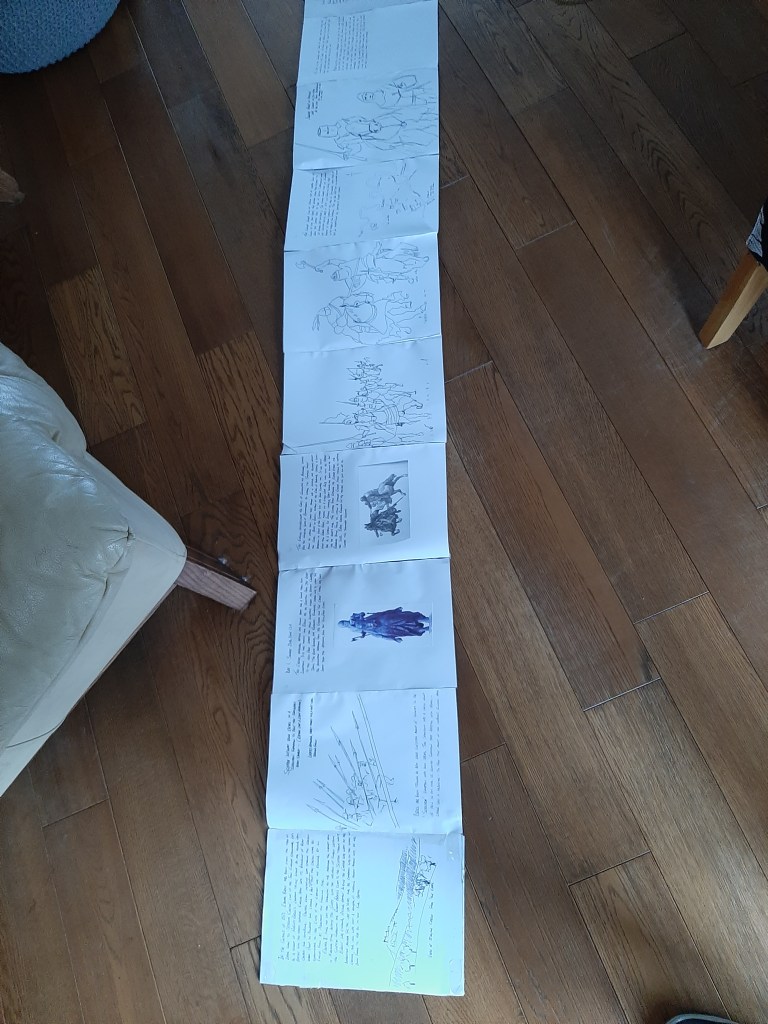
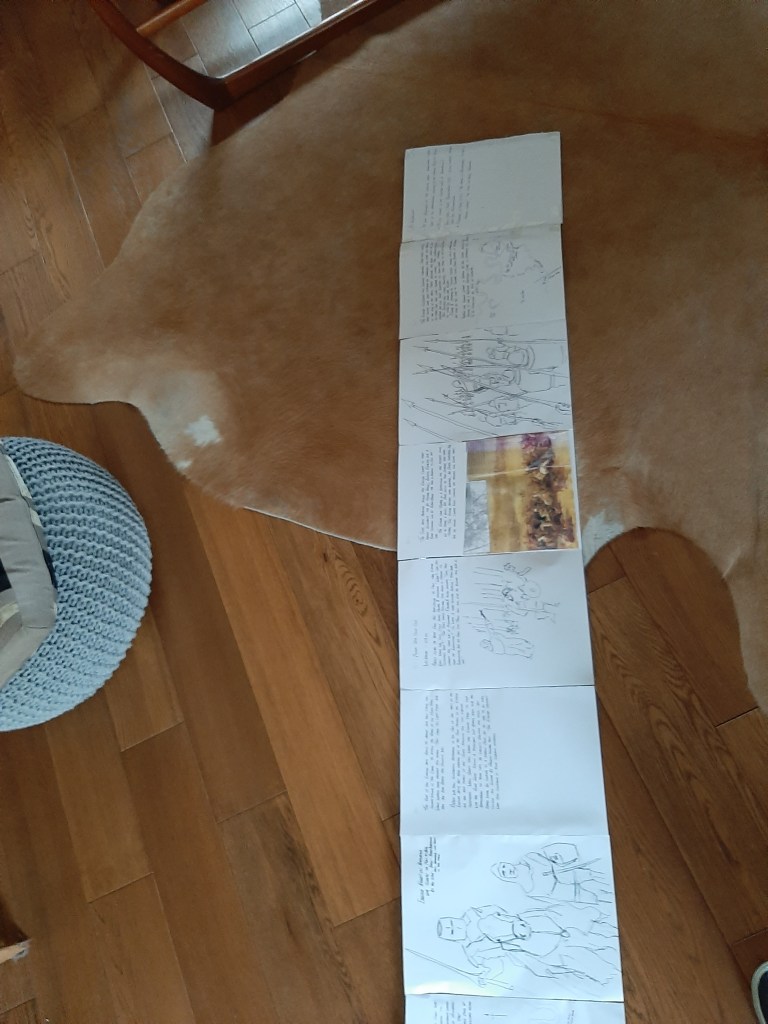
I took two images from my A3 sketchbook that I painted in oils based on a favourite topic of mine, the Scottish Wars of Independence and the Battle of Bannockburn. One was the statue of Robert the Bruce at Bannockburn by Pilkington Jackson, the other was a copy of the actor Chris Pine portraying Robert the Bruce in the film ‘Outlaw King’.
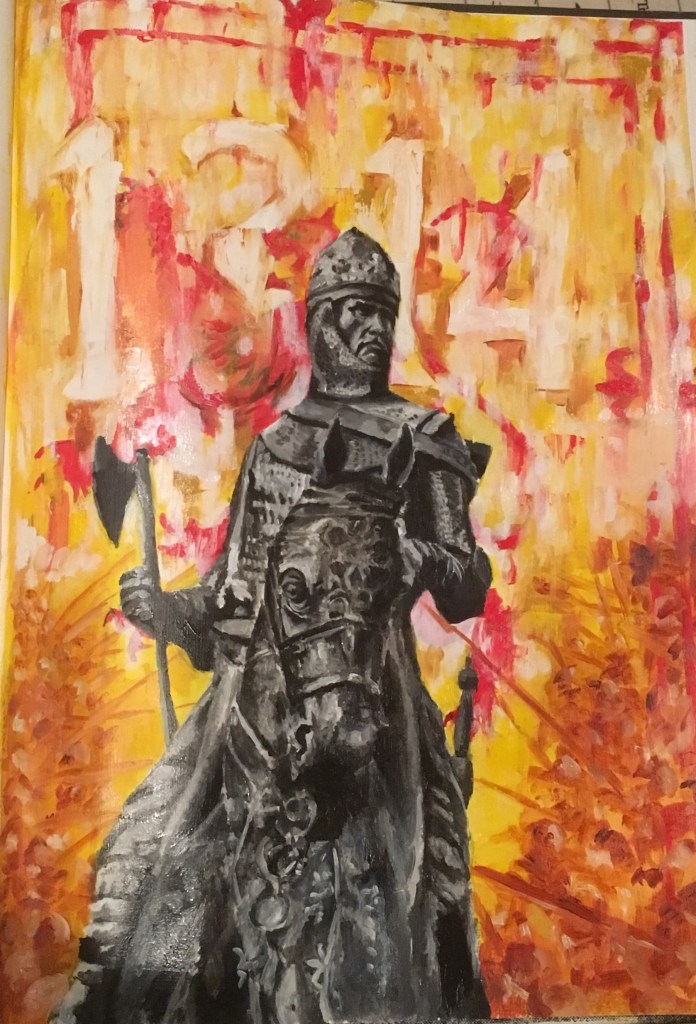
I have always wanted to do a series of paintings depicting the stages of the battle, so this project was a good chance to explore this possibility, so here it is. I would like to add that I was interested in Botticelli’s depiction of ‘The Divine Comedy’ with his use of line with pen and ink. I wanted to copy this style of mark making with a focus on the linear illustration aspect. I will attempt the oil paintings at later date!!



Next, reflect on yet another aspect of time as you experience what it’s like to lose yourself in the concentration required to work in a very highly focused way.
Reflection:
Because I was working on a subject that I am very interested in, the time just disappeared, I was very focused on the job and the hardest part was not going too in-depth on each part, I was condensing the events of two days of medieval warfare into a concertina fold of A4 pages that would unfold to tell the main points of how a battle took place. The drawings were very linear in nature, and one day I would love to do oil paintings on a large scale of these events, using correct topography of the land, period costume and armour and heraldry. Because I have been thinking about this as something that I would love to do one day, it was an easy exercise to get involved in. The exercise of using the concertina fold means that I was conscious of trying to condense the project a bit, it is also nice to have so much information on one topic contained within an A4 space, its a bit more personal than a folder or a binder, although I think I can foresee a sketchbook being devoted to this sole topic with a trial run with the oil painting ideas.
Project 3: A finer focus
Aim: Gwen Hardie is an artist who makes careful drawings and paintings of small areas of her own skin, Richard Wright is a former sign writer turned Turner Prize winner who makes intricate wall drawings. Grayson Perry is a ceramic artist who makes detailed extended doodles. Jim Shaw combines exquisite naturalistic detail with complex cartoon imagery. Do some research into artists who work in a similarly painstaking or meticulous way, something which arguably has become one of the most significant features of contemporary drawing. By making a drawing of your own which involves focused effort you’ll be in a position to reflect on how this affects your relationship with the subject and the process and what it communicates to the viewer
Method: Choose a subject which has a substantial number of detailed parts. Think about whether these parts will be repeated (a plate of baked beans, for example) or all different (a hyper-realist drawing of pins and nails). Consider also whether the parts will be drawn from observation or invented (as in the work of Paul Noble). Remember that the original subject may not be primarily visual (in extended doodling, for example); you may be using drawing to describe a narrative or even musical score, so that the imagery is secondary to the relationships between the elements.
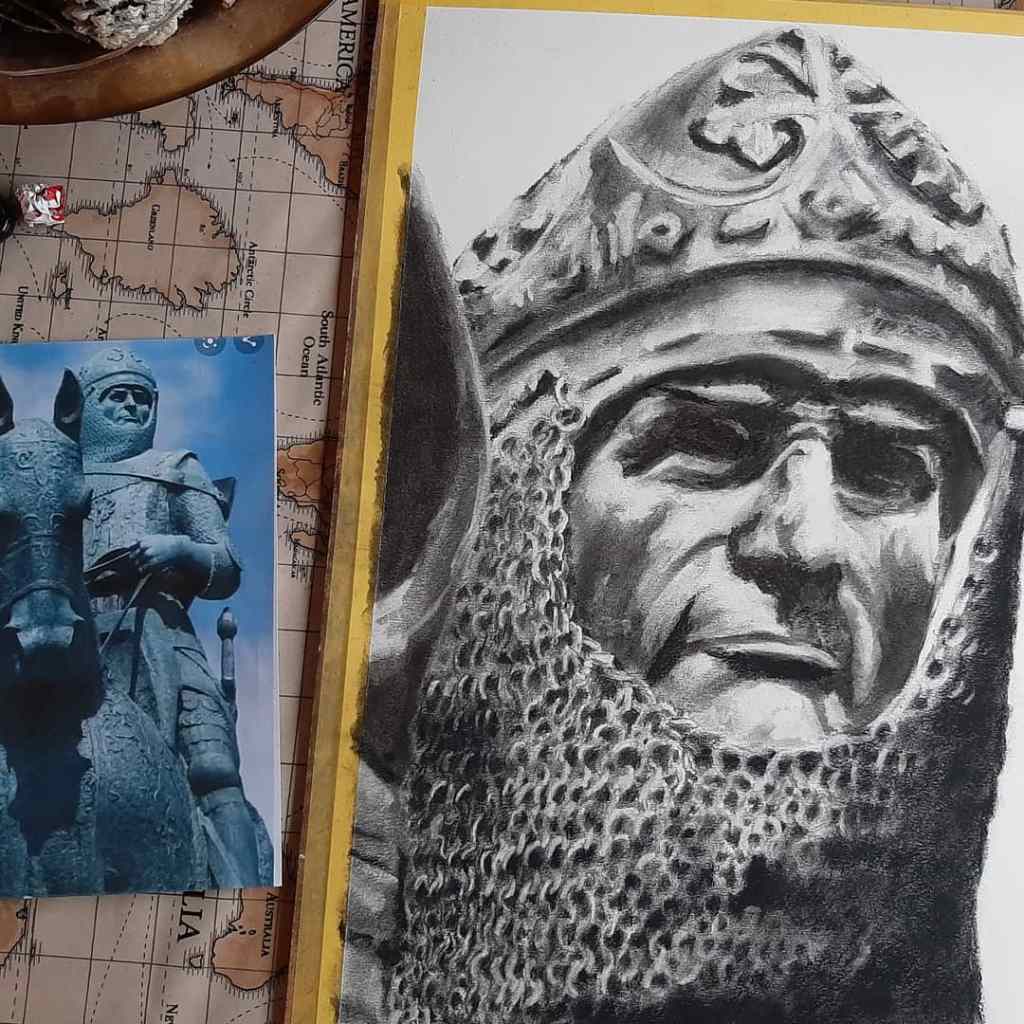
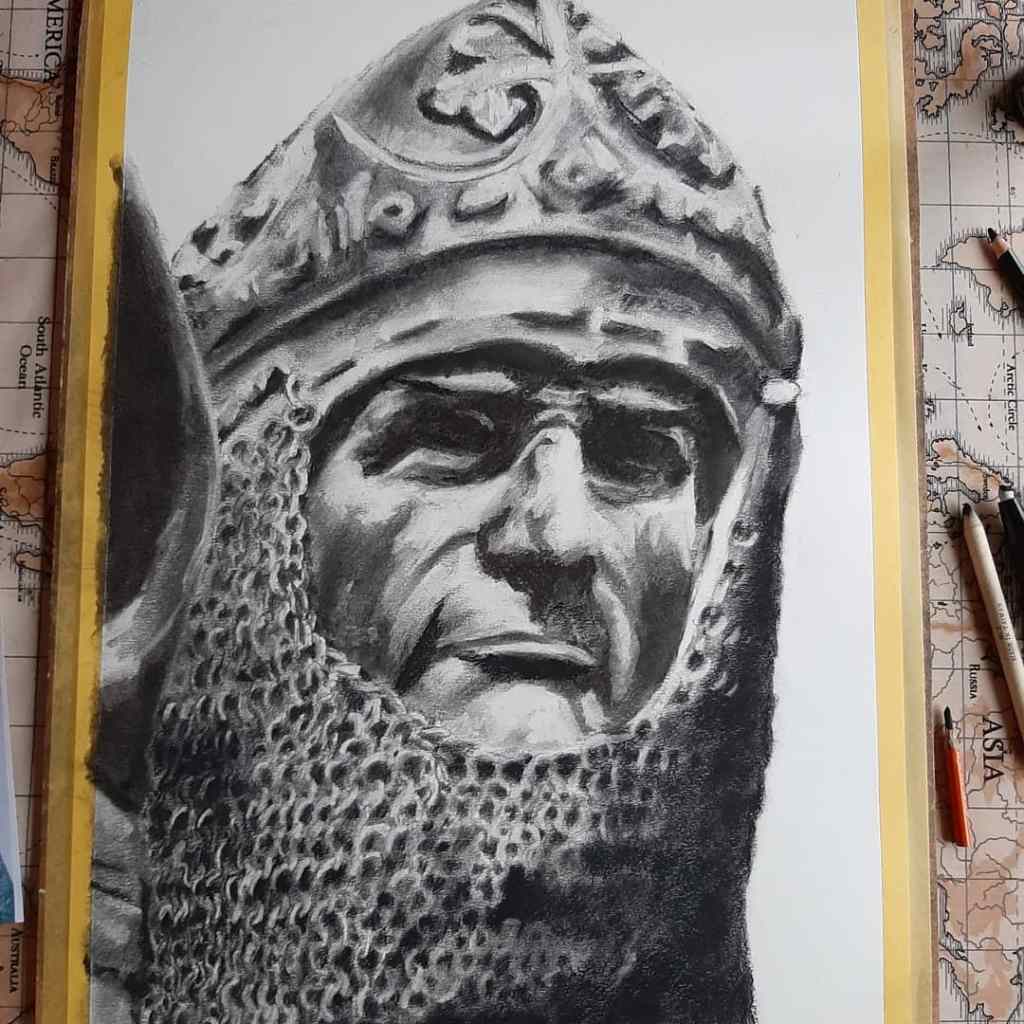
Following on from the Artist’s book project, the chain mail on Pilkington Jackson’s statue of Robert the Bruce at Bannockburn would fit the description of a repeating pattern within a detailed drawing. I was trying to be careful to maintain the statue quality rather than a flesh like appearance. I decided to work on a large scale – A2 with charcoal medium rather than pen and ink due to it’s blending nature. I understand that graphite can produce a broader spectrum of dark’s where compressed charcoal only has three different grades, but I enjoy working with charcoal which I sharpen to a point to achieve fine detail. I liked the difference in perceived textures from the smooth helmet to the jewels in the crown circlet on the helmet and the grim determined expression on the face and lastly the intricacy of the chain mail. This last point was very hard to achieve and was built up over many layers which were blended, highlighted and sharpened time after time to achieve the likeness I was looking for. A finely sharpened graphite pencil might have been better to achieve crisper detail for the chain mail, but I feel I might have lost something in the facial expression given the size of the piece.
Reflection: Stephen Walter is a contemporary artist who works a lot with drawing and mapping. He works in such detail that the viewer needs to use a magnifying glass to experience parts of his artwork. Look at Walter’s work, read his comments and reflect on them in your log. What does such a fine level of detail lend to the image?

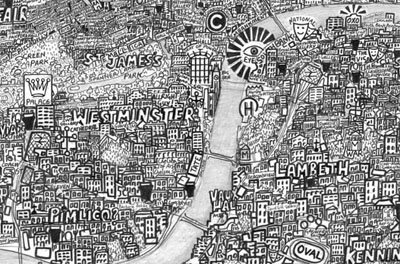
Stephen Walter’s intricate work of drawings of maps which contain personal reflections on certain areas, memories of buildings or names of areas that were specific to the artist. I was interested in his comments in the May 2015 Guardian article by Tim Adams about other artists who employ others to do some of the work for them but he wanted to maintain his integrity of completing the work himself ( at the risk of losing his eyesight and his mind through the act of being so careful in representing such fine detail). I am intrigued by such levels of attention to detail and hyper-realism as an exercise in its own right and I admire the mental strength that this requires. While I do appreciate this as an art-form, I prefer art which has a bit more emotion or feeling in it but with underlying realism or representation. I feel that work that is so hyper-realistic that it might as well be a photograph loses something, not taking away from the artists skill or dedication, but for me there has to be something else to be offered to the viewer. When the viewer looks at work with this level of detail, I feel that there will always be a reaction of awe at such attention to detail and this will make the viewer stop and look for more little surprises – particularly with Walter who places his own thoughts and memories and interpretations of actual places in his maps of cities. Other examples of his work can be found in TRACEY,(2007), Drawing Now – Between the lines of contemporary Art. p88-90. The introduction of this book discusses the idea posed by Petherbridge about outline drawing being the most conceptual means of drawing, that the process of outlining an object that doesn’t have an outline is itself very abstract, – and takes it further to examine what else drawing could be, including thought (p.14), and Walter’s map drawings fit this criteria. The artist has given the viewer a clear insight into their own personal thoughts, all the viewer has to bring in order to enjoy the work is good eyesight, there is no ambiguity about the work, which for me is refreshing as I struggle with art that is more open to interpretation, I prefer a clear narrative, and that is the beauty of art that it encompasses such a broad variety of styles and tastes.
Guardian article 10th May 2015 by Tim Adams https://www.theguardian.com/artanddesign/2015/may/10/stephen-walter-artist-map-maker-london-interview Accessed March 2020.
Stephen Walter Map image 1. https://www.google.co.uk/url?sa=i&url=http%3A%2F%2Fwww.tagfinearts.com%2Fstephen-walter.html&psig=AOvVaw3KmQfh3sel5Xnp2Jd0WlOU&ust=1585227571219000&source=images&cd=vfe&ved=0CAIQjRxqFwoTCMi2rpLXtegCFQAAAAAdAAAAABAI Accessed March 2020.
Stephen Walter image 2. https://www.google.co.uk/url?sa=i&url=https%3A%2F%2Fblog.ltmuseum.co.uk%2F2011%2F03%2F17%2Fstephen-walters-maps%2F&psig=AOvVaw3KmQfh3sel5Xnp2Jd0WlOU&ust=1585227571219000&source=images&cd=vfe&ved=0CAIQjRxqFwoTCMi2rpLXtegCFQAAAAAdAAAAABAO Accessed March 2020.
http//www.stephenwalter.co.uk/home.php
TRACEY, 2007, ‘Drawing Now: Between the lines of Contemporary Art’, I.B. Tauris & Co Ltd, London & New York.
Project 4: Time and the viewer
Aim: Make a drawing which forces the viewer to use time differently. This may mean a drawing which takes time to make sense of, or a drawing that creates a feeling of a certain pace. The drawing may need an investment of time by the viewer in some way. A drawing is a record of the time you spent making it, but the viewer also spends time looking at it, perhaps seeking meaning, enjoying its beauty or marvelling at the artist’s skill.
Timelapse video of painting below can be found on Facebook page ArtbtNeil – cover image is a Barn Owl.

Reflection: Reflect on the time spent by the viewer and how it relates to what you do as an artist.
From my own direct observations of people in art galleries and museums they will typically spend no more than ten seconds in front of a painting – even masterpieces – which I find extraordinary as I can spend minutes and hours in front of pieces trying to dissect the artists process, the colours used, the manipulation of paint handling and when I think of the time the artist spent painting each layer and drying time in between if painting in an indirect way or even drawing in painstaking levels of detail and refinement, which might have taken more than a year to complete to be viewed and dismissed within a minute seems a bit unfair. I think this is perhaps more of a reflection on today’s society which has a throw-away value and instant connection with the internet everywhere which would be a natural value for artists to react against and comment upon. Being interested in drawing in detail myself as a key part of my own artistic process I am interested in the personal content of Walter’s work which many people will never see by virtue of not taking the time to look, however those that do will continue to be surprised by what they will find, and that is a reward in itself to any artist, the appreciation for doing a job well.
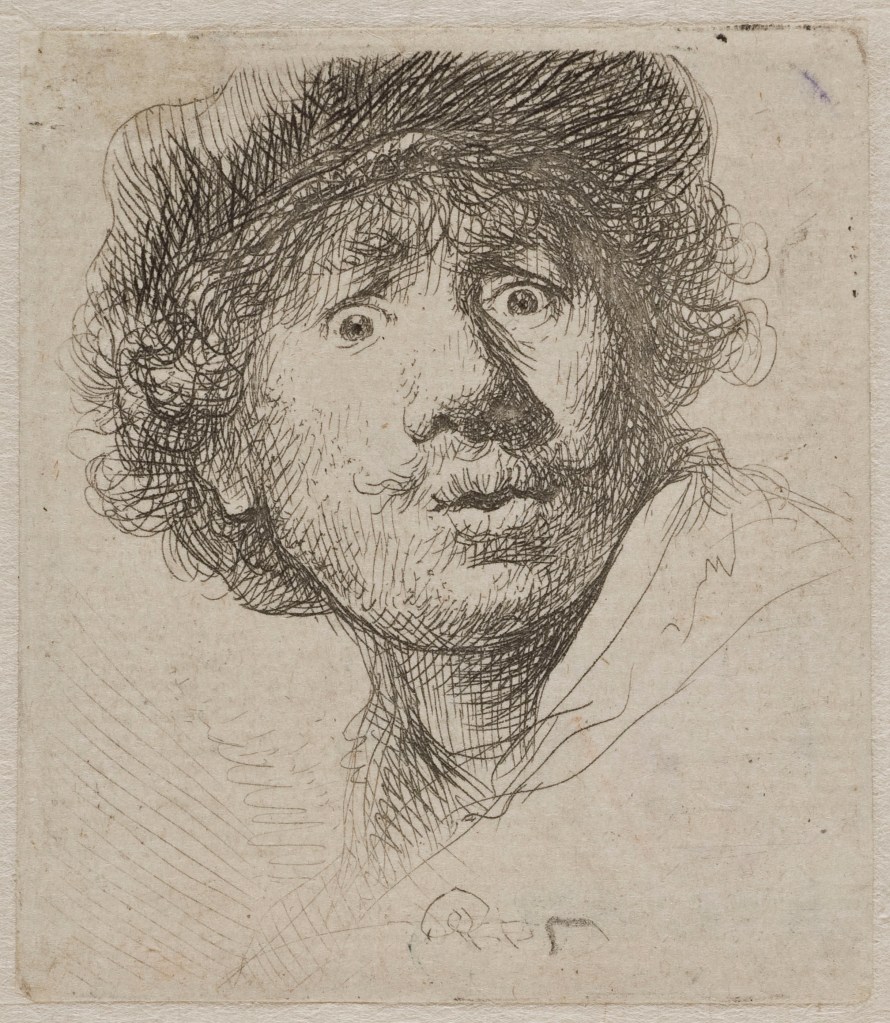
Just before the country entered the lockdown from the Covid-19 virus, I was the artist in residence at the Cass Art store in Glasgow on Sunday the 15th March, where I did a live demonstration of an oil painting. I chose to turn a Rembrandt etching into an alla Prima portrait. I was placed on the window ledge of the store so that people outside could see and anyone was available to chat and ask questions. I had four hours to complete my task which I recorded via a timelapse on my phone and this footage was only condensed to half an hour, it can be found on YouTube, I have also taken a screenshot of a comment from Instagram from a member of the public that day.
Timelapse video of 4 hour portrait demonstration in Cass Art Glasgow 15.03.2020.

The experience of painting in front of a live audience who were interacting was certainly different to painting in the privacy of your home studio. I loved the reactions from the audience as they saw the image taking shape, they became engaged and asked what I was doing and why, this gave me the chance to talk about something I love to do and hopefully impart a bit of knowledge. People were keen to see what I was doing and spent more time watching me paint live than people do in a museum looking at the works of great masters. Knowing that more and more people are turning to promote themselves with tutorials on YouTube channels, I wonder if their success is because the barriers are broken down on the process, it becomes a more visual experience like television for the viewer, which they are comfortable with. I would still prefer to visit galleries and museums to experience finished works direct in situation.
Contextual focus point: Frank Auerbach’s portraiture
Frank Auerbach approach to portraiture is legendary and through it he makes some very interesting points about the nature of portraiture and of drawing. Research what makes Frank Auerbach’s portraits unique, and how he used the passage of time in them. Think about why he might have done that and make notes about how working from life differs from working from a photograph in terms of the way we experience the time spent.
http//www.tate.org.uk/art/artists/frank-auerbach-676
“When I was young I was greatly moved by Rembrandt, I felt I stood more chance with persistence, digging deep, then something reasonable happening simply by laying seige to the subject. It’s just what I was capable of. Some people are natural draughtsmen. I sometimes feel sorry for them – you have to work through that to something deeper. I don’t know how you would break up an easy virtuosity” – Frank Auerbach in an interview with Jackie Wullschlager


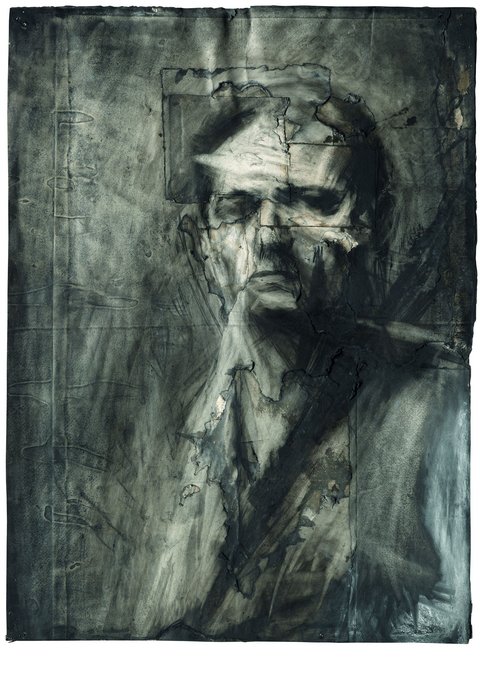
British based artist Frank Auerbach b.1931 in Berlin, moving to Britain in 1939 as a refugee from the Nazis and then settling in London in 1947 where he attended art classes taught by David Bomberg and became friends with Leon Kossoff. Auerbach was associated with a group known as the School of London which included Francis Bacon and Lucian Freud – although he said that he has never felt a part of any group. Looking at the portraits above, his style appears scribbly with lines that are worked, erased and re-worked (to the point where the paper has been worn through and has been patched to produce the final outcome. I initially believed this was a gradual build-up, I did not realise that Auerbach’s process was to completely re-work the entire piece if any aspect did not work too well. Rather than fix the one bit that was not pleasing him, Auerbach would completely rub-out or scrape back the whole work and start all over again so the finished outcome is the result of many previous attempts that have led up to the final perfection. In some instances this might have been thirty to fifty times. He uses the same process for his landscapes, so this is an essential part of his artistic process. In a strange way I am reminded of Rauschenberg’s ‘Erased De Kooning’ that the rubbing out is an essential part of the process. For Auerbach this process was to start again, to achieve an outcome in one sitting which is a bold approach. Auerbach had a select few sitter’s including his close family and the process of constantly drawing and re-drawing the same object/sitter over and over will develop an intimate knowledge of the object/sitter which of course will be transmitted to the canvas for the viewer to then admire. By drawing from life and not working from photographs, the artist gets to know the person on an emotional level – especially if its a regular sitter – and this emotional link has to be transferred onto the canvas which the viewer will then pick up on. There is a three way relationship which starts between the artist and the subject, the artist and the canvas to produce an outcome, and finally the viewer and the finished outcome. Auerbach’s influences range from Rembrandt to Titian, Constable, and Picasso where he picks up on the intimacy of the subjects. The act of looking at someone as intently as you do when drawing them is an intense experience, you are looking to identify their likeness and a bit of their soul as well.
Fig 1. Frank Auerbach self-portrait , https://www.tate.org.uk/sites/default/files/styles/width-480/public/images/frankauerbachselfportraitid006.jpg Accessed March 2020.
Fig 2. Frank Auerbach portrait of Leon Kossof 1959, https://www.google.co.uk/imgres?imgurl=https%3A%2F%2Fscva.ac.uk%2Fwp-content%2Fuploads%2F2019%2F09%2FCopy-of-9.-Frank_Auerbach_Portrait_of_Leon_Kossoff_1959_UEA38.jpg&imgrefurl=https%3A%2F%2Fwww.sainsburycentre.ac.uk%2Fart-and-objects%2Fportrait-of-leon-kossoff-frank-auerbach%2F&tbnid=eisqMLHLbESMlM&vet=12ahUKEwiy-bH_3rXoAhWB_4UKHROdBEMQMygEegUIARDjAQ..i&docid=tREcAKK0SSRDgM&w=1920&h=2382&q=frank%20auerbach%20portrait%20drawings&safe=strict&ved=2ahUKEwiy-bH_3rXoAhWB_4UKHROdBEMQMygEegUIARDjAQ Accessed March 2020.
Online resource, Tate – Who is Frank Auerbach https://www.tate.org.uk/whats-on/tate-britain/exhibition/frank-auerbach/auerbach-introduction Accessed March 2020.
YouTube video When Stephen Smith met artist Frank Auerbach https://www.youtube.com/watch?v=IuSSrWf1fLE Accessed March 2020.
Reflection on assignment – up to 800 words.
I enjoyed the artists book exercise as I took advantage of using a favourite topic of my own personal interest, I could easily have gone into a lot more detail and depth for this subject because I am naturally passionate about it, and I also tried to emulate Botticelli’s style of pen and ink from The Divine Comedy when I was portraying knights, horses and infantry from medieval times. I also used the same subject for the exercise on fine detail. I think I could have pushed the detail a bit further to be more photographic with the chainmail links, but the vine charcoal medium doesn’t lend itself to fine detail but it did depict the bronze surface pretty well in my opinion. I partly think that the slightly looser approach to the exercise was a result of my research into Frank Auerbach’s portrait style which did also influence my parallel project of producing a less finished style of drawing where I worked on a self portrait in charcoal on toned paper with a lot of smudging and blending to suggest form rather than depict it with lines. I was pleasantly surprised at the change in direction my artistic style was taking in response to this research as it really is not something that I would naturally have arrived at when I started Drawing 2 where my inclination was more of a traditional classical style. I would like to think that I am open to different artistic styles and approaches, but I am fascinated in traditional academy style of learning to draw well before developing an artistic voice or message that will be better conveyed by that ability to draw subjects well. My tutor asked me to provide a canon of work across different genre’s as an exercise to really test your taste in art. I have always known that I really admire work by the old masters, but there are more recent and contemporary artists whose work I also admire.
Here is a canon of works across the main genre’s that I would choose.
History/Religious


Portraiture


Genre


Landscapes.


Still Life


My reasons for the above pictures range from having seen them first hand in galleries, or just studied them in reference books or indeed through social media platforms such as YouTube.
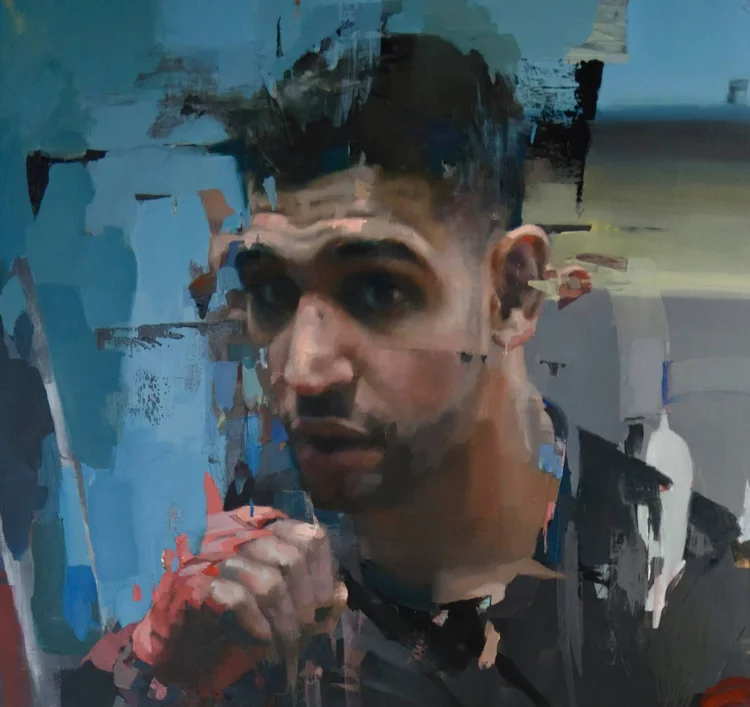
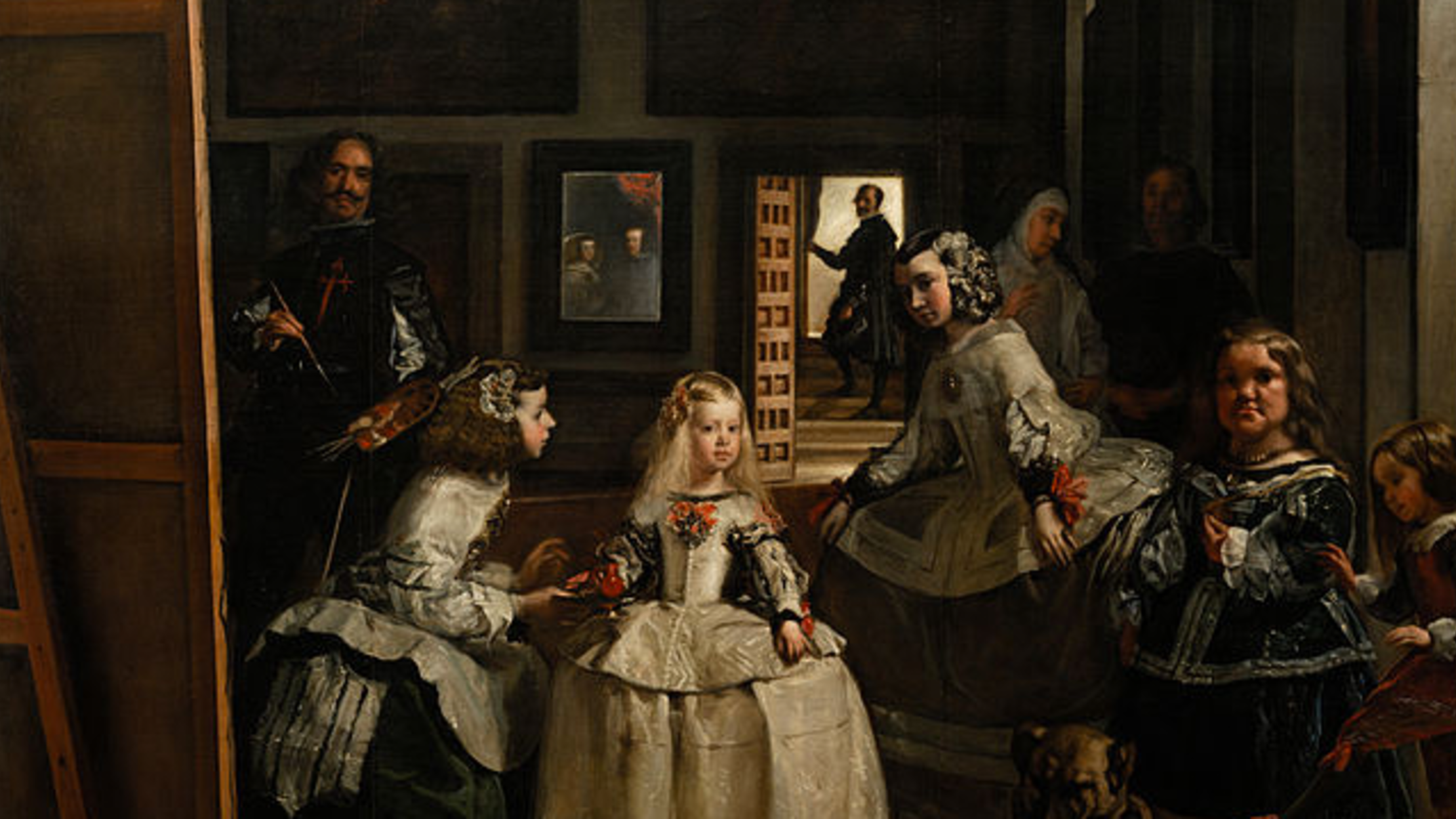
The Historical/Religious paintings were as a result from visiting the National Gallery in London where I saw the Hayez work, in fact I did an annotation in my A4 sketchbook while I was there of Susanna at her Bath, I appreciate the iconography with the vine on the wall and of course the voluptuous form of the female nude. Rembrandt’s first masterpiece, a scene which he imagined from a simple text in the bible, yet it was hailed as being revolutionary because nobody else had ever thought of it. Judas trying to repent for his sins, there might be some good left in him. Beautifully painted with strong light and dark as used by Caravaggio and the trace of a mistake, the original positioning of a money bag which is now painted over next to Judas’ knees. This adds interest for me. Portraits are such a vast range to choose from and I have started with my two favourite contemporary portrait artists, Cesar Santos and Christian Hook. They both have classical training which clearly comes through in their ability to portray the sitters likeness, but they add a bit more with their own process. James Guthrie’s portrait of Old Wullie from Kirkcudbright in the South West of Scotland which hangs in Glasgow’s Kelvingrove Art Galleries and I have admired it every time I visit, I love the way it looks as though it was painted in a direct way with a painterly style, but this was actually finished in the studio painted in the French Academic style. The painting process of a smooth finish was taken to its most extreme level by Bouguereau who’s brushwork has never been surpassed. Many thought he used badger hair to smooth the blending of his paintwork, but he actually used a thick application which was then smoothed with the palette knife before subsequent thinner layers with more oil or glazing/scumbling techniques, and I greatly admire this process. The Genre painting was never done better than by Vermeer, there are many examples of his work that I could have used but for me Milkmaid has that added extra because you can visibly see the pin prick where he drew his perspective from by tracing the window panes back. Velazquez, the painter’s painter completed his finest piece showing the artist as being worthy of being in the royal household in this piece. Landscapes never fail to take my breath away with stunning scenes of natural beauty and Shishkin painted a bleak winter forest scene with hardly any colour but it is as worthy of praise and awe as his other masterpieces in full colour. Contemporary artist Andrew Tischler was heavily influenced by Shishkin and he shows his process on his YouTube channel. I also admire the Scottish colourist Scott Naismith who paints scenes from the West Coast of Scotland, favouring daybreak or sunset when the clouds reflect the colours in the sun and the sky. Still Life was perfected in the Dutch Golden Age which co-incided with the invention of magnifying glasses to study details and a wealth of exotic flowers being shipped along the Spice Route becoming available for artists to paint. Willem Kalf helped to make this genre rise up in prominence. Morandi showed how the artists own view and interpretation of objects can be as powerful as the composition itself. I love the limited palette in this piece. I hope that this helps to show that I realise that I do prefer classical art, but I am certainly not blinkered in my views and I see classical style as a sound platform from which an artist can grow.
Image sources
Susanna at her Bath https://www.google.co.uk/url?sa=i&url=https%3A%2F%2Fwww.flickr.com%2Fphotos%2F91590072%40N04%2F15739218803&psig=AOvVaw17NujDIDeaBe4JG2LYC3Fg&ust=1586601208423000&source=images&cd=vfe&ved=0CAIQjRxqFwoTCKDzx6HU3egCFQAAAAAdAAAAABAH Accessed April 2020.
Rembrandt, Repentant Judas returning the thirty pieces of silver https://upload.wikimedia.org/wikipedia/commons/thumb/c/cd/Judas_Returning_the_Thirty_Silver_Pieces_-Rembrandt.jpg/1200px-Judas_Returning_the_Thirty_Silver_Pieces-_Rembrandt.jpg Accessed April 2020.
Amir Khan (boxer) portrait by Christian Hook https://images.squarespace-cdn.com/content/v1/57ceaf32e58c6267c22de2ad/1474457098169-Y8FPKCY0NB48Z9KTPPMG/ke17ZwdGBToddI8pDm48kPPdSBKhaOmNwGXQ9ltdv9J7gQa3H78H3Y0txjaiv_0fDoOvxcdMmMKkDsyUqMSsMWxHk725yiiHCCLfrh8O1z5QPOohDIaIeljMHgDF5CVlOqpeNLcJ80NK65_fV7S1UcopMwgosm_kyGWjo3tOQOkJlWo6iv3ABKoqtgBffiogXnSB3YPkR200zhDcPpofhQ/10473454_597944026972310_403620575241023218_o.jpg?format=750w Accessed April 2020.
Jordan Peterson by Cesar Santos https://i.redd.it/5qefp60k6wb11.jpg Accessed April 2020.
Old Wullie the Village Worthy by Sir James Guthrie https://artuk.org/download/old-willie-the-village-worthy-84335 Accessed April 2020.
Gabrielle Cot by William Adolphe Bouguereau, https://upload.wikimedia.org/wikipedia/commons/thumb/0/0f/William-Adolphe_Bouguereau_-Gabrielle_Cot–Sotheby%27s.jpg/636px-William-Adolphe_Bouguereau–Gabrielle_Cot-_Sotheby%27s.jpg Accessed April 2020.
Milkmaid, 1658, Vermeer. data:image/jpeg;base64,/9j/4AAQSkZJRgABAQAAAQABAAD/2wCEAAkGBxMTEhUTEhMVFRUXGRcYGBcXGBUXGBgXFRcXGBcXFxcYHSggGB0lHRgXITEhJSkrLi4uFx8zODMtNygtLisBCgoKDg0OGhAQGC0lICUtLS0tLS0tLS0rLS0tLS0tLS0tLS0tLS0tLS0tLS0tLS0tLS0tLS0tLS0tLS0tLS0tLf/AABEIAO4A1AMBIgACEQEDEQH/xAAcAAABBQEBAQAAAAAAAAAAAAAEAAECAwUGBwj/xAA/EAABAwIDBAcFBgQGAwAAAAABAAIRAyEEEjEFQVFhBhMicYGR8DJCobHBFCNSctHxBzNi4YKSorK0whVzdP/EABkBAAMBAQEAAAAAAAAAAAAAAAABAgMEBf/EACoRAAICAgIABQQCAwEAAAAAAAABAhEDIRIxBBMiMkEUUWHwQpFxgaEF/9oADAMBAAIRAxEAPwA/a7TRfTxDGk5WFtYDV1IZJIA1LSc3gRvVO26bXUabmkEEEg7iDhzELpKjJc3hlcP9v6Lk6tDqWtpH2Hy+nJ9kmi/PT7veHiNwXLL2s3j7keZYOzhHD9EDtkxUE/hCPwftDu/RA9Ix94PyhaQ7Jl0aezK2amJ1Fj4f2hHNaszY3snv+gWqFElsaei1jFcKag1X01DGTpUlsYBkIGmFqYQJDNjBsC1qLZWZg1p0HIEWtoBXijooYXDtbMaEl3i4yT5o9jArSEyhtEK4MCtyBLKnQrIZUnNCnASyhFCKTSCkaasyp4RQWU9WlkCtISDUUFg7qA4BO2kFeQk1qKCyh1IcEPVpcFoQqnsRQWZ5ppKytSukgDD2FiHAtoVZloeabtc9MGBJ/E2IPEQeKp2/hw+g0Hg3zFKpB84RuLwXW06eV2V7Mz6bh7rhMHmCDBG8FAVa7q2HkMLajCA9lrfdVTInUECQefIpT9rKj7keSYfUd36ITpG37xv5UTQN/XJGbQw4eB8/FWnTE1aBNjex4/QLVagcHQ6sETM30hGUylLsF0FUyiGaoWmUSxQUHUtFr4VtlkUFr4Q2CQzbwLLLRptWXhHLTolIA6m3RF0wbzHLuga+MoSi+QPqIV4eqQmXpKvMpAqiSQUoTBPKYhAJQnTwmBCE8J0olAhoTgJAKSAGUCFYmhIYE8XSVlRl0kWBhbGxjKzKLqZDhkdPJwyAtPAi6ytuUjTDa1P28jabgdHMNOqbjiNx7+KevhXYepTxGHaDNIGtT0DwAwZm7mvHHfF1dtPEsqYYPpmWzHMFtF8gjcROimftZcfcjx+kLj1wVlbExUjhM85iPJRoC49cELiX/fuB3n/qFaRDYb9oB5d6MwtPNN77u/mstnrwRdJ3AqGzWMUaNCi6M0cQQNQRxV+CcSAXCDvHDxVWDxZYe/h5aabvgiG1w51gL6xYTM6X3EDUqeQ3CjRwwWrhmrKwy1cKU2QauHNkdSqlZ9AoljkIGaNKsiWVpWe1yu6yAmI0G1UbhqDnX0HEys+jiaNEdZiajaf4Wu17yNe4IzB9KMHVEMr0s34S7K7wa6ChCZfUpxPaaeQ1tyQ1HENeJb5EEETe4Nx4qja+IytzAiYN/iIlchsjbZGPhwI677tzTuc0uLXd50P5uSaewo7xrlIFVZVY0KyCSSSeEhjBOEydACSCSYFIZS8J1F6SBHM47+W3/wCYn/Ysva2BysL6dibPb7rvuHHMR+IcVVV25pTxLRRqdQ5rTM06nskFjtxgeybzYStfarYpO5F3/HclL2s0j2jxyh7Q7v0Q20qfbBG8ojCntR63J8eztU+Z+V1S0QyuOKsp6qdRv1SpXKzs2oPpNt63+iiGsIy2iSCfPfz1VVFkmPXrTzRbsQAYIsNTGhWceypdGlh1q4ZZGHdIWlhnrVmRp0HIljkBSci6ZSBhjXJnOdkc4aNtP9R08hJ8lTTJJDBdxgeJRW2cQAxtFsQ2SY953E/FJ9AuzO6KYdgzVq/aJJDc1w1jbCOZuSe5VdKTh67Tma1w3WFgNIWTtmviKWRtA9ZTeA0tDQcrouDFxxnS65jGY45303zIMGNJBgys1bOukkTwm3K1A9VmL6JMBpMlgcfdnUDgtXoxXdVx1CfaDyf8rHOPyK5XFGxcDpceGi0MHjDSrsqsmWPDhG8TceIkeK1RzTVM94arAh8PUDgHDRwBHcRIRDVoYkkgkouqAEDedPC6TYyaSdJAhJg1SAShAwZ7CnVjwmQBxu0cE2oHMc0OHUix5Ex4yAs3FYSrQa5jHl9EueAx1305oEjK/wB5oFoN7a7l0DwHZ3NIcOrsQQQQc+hCF20IY/8AM7/jkJS9rLh7keN4D2z63BFbRbdh0AnzI/dV7Nb2u8fojdp0czE72IDiVOnSj5+KEdTygQSLKQxThzUOL+C1NfJs4ZwAc9Qo1eOpus2pjSWAAb79w/cK/BU3uk27In2m3EiYg804xpbFJ29G7gyBYbj8FrUHLnsLW0JEBwB8xzW1h3pkmrQciW1FmUaqv65IAqnWyuBzZecG3lopOfLjoVbs/Zjqjc7pa0wG8Xk6RwHNdHhsC2mAxgGY+Z4knWAubJkSlS2zVR1ZxDdqto1Huu1zWns2GcxoHG06GN8LgqIa4uLhMzvjW8yvXumnRR1YfckTl7QdN40MzqeBG7cvLdp4V1I5CyCLLVaNOaaRkYp1iALI/BAH5fBLZ2xqtd0Mbbe46Lbd0WfSaTmuL6Qm5xjqzJpydnqmwHD7PRjTqqY8mALUYVynQTaTalAU5+8pyHN4XMEcRG/kusYtU9GLVMmE5CQToASSSdACSCSYIAiSkolySQHzpgcfVpfy6j2flcQD3jQ+K229MK5Y5lTLUmbnsuuws3WOs6Ln8g5hNlRSZVtFmz7ug/h/Ra1YWWRhnZXybCNfJa2cEWMoAyMQy/kPKVU0IvEtuVVkVEjYbCtee08NgHWYtp3cJW9snEYejRILmio/QmHQADFt0mPPkuerQGy6ecKAxdK4FI3MyItyEu0UuNlp0b1FsU2NdY5T/pcRPrij8FWkBc6KruzwbMdy1MDVVVom9m62oi9m0TVqtZEiQT+UXd8FkMeul2VSbTBJcA4gkibgQdI5blErrQOSjVnSYNudzCNGy48NMrWjgNdOCq2Vtxzq9csZLGhtMOJ99pcXQI0uJ424KB2m37FUr079hxaBvgQPDf4qGzaHVUGMG4XNpJkkk8ySTPGV58U4O/k6W1Ja6Nt22AGQab3POvsgSba3geC5/FbIbiDNUCJu1uhjc52rvgEquMHHvWfiukjWbxYHzvAVyyTaJUUatKmxp6miGtyAF3Z3GwDefNC43Ctcw8bzN96ysJtUmm2qY6trQXm8udULnBpGhsAf8S0cM53VZ3zLwSeX4QPBYtNGv+DnXn7NVbXpiCD2gPeZPaafD4wvT8HiA9rXNMhwDgeREheW7XxTS0gnj8l1H8M9pdbgw060nOp+A7Tf9LgPBduB2tmGZbs7SU8qLSnW5iOFJRCdMB0yaUgUAVOSTOeEkxHzmowpBqcNUlkQtDDWagmsR+FFkAUV23UQFZWPa7/X0TBqBEcoSyBSToArhEYJ14WhsfYVSvcDLT/G6ze4cSrMTg6FGpkNV5IIzQwEWvHtBHJXTLWOVXRp7FwJJzuBAGmljxLStPauIDA0O7TbEP0c1o1JaLkXHaExvWLtHFU2ND6dVr2GxsWPZwJF5E7wVzuP6SvLg1zQ7J7DjqOIPIi0ecq+Ori7Rzzi+Wzu9mPL8JjaVPQA5ASPfaZ03WnzRTcaTSa4GQRO4fKywf4f7Rz0sS0DSjI3WBfE31utDZ7fuaf/AK28Y0AC4ssfW/34OnE/QgDHbRg3mPn5LmMdipJ4Le2th5nlzXNVGNzNDjDSbmwhs3N+ScIpmjdI6zYFIGlRZVqiAXOa3SM5aWzxgB3+bkF1G0sTTguDgWt57+Q3rmMPicC0waugFnEtIFosQCBBHmsHpBtR2Ymm8hsAAC4NuacsKm9WjBZpR7oF2rjC5zjPHThuXf8A8IaThhqpOjqtvBjQV5fSxAecsQXEDlcxpuXv2x8C2hRZRZ7LGho58SeZMnxW8YcFQ5ZFI1GmydVtKnKZBMFOFWCpApiJJmp4SagCBYEkikkM+faeF5hTGHgTqrqZ0UnFIsqDYUgbnVWAKk3ndomIprC/rmoq2qVVKBDlG7Ew7alemx3slwn5x4wg1dgzD2ukjL2iRqA29kn0VHtHRdIdofaHvc2p1eHwxY0NDSHO7WV0N3RGhG4rnKwfUJqtbLHEkbyAdAecQs/GbRIJcNJJ1vJ3k7zzV+zKhxJLWuIqAFzSLTG4xrOk9yXBpHTKUW6T2XPeA05hA3ysSnhy90u1sY7xz7wuiwtZtRhZWE2kHjF78+awhVMyOHoLs8DhTb5HB4zI41R13Qza1LC06zXyBVkMfEwRIALReCZ8l1uBqUjh2ZHtflY2SHA3jfFwTqvKKOK9kR7Jme8mR5FSbiYFjBnXfBdw32la+I/8/HN8oOvuc+LxU46krO72xSGo3+vBYezdmtqlz3OLcrsoMAjTtWIPERY6acK9k4PG4gEYdtWoNJJOUCd7nGPiuqPRHHUMOS00HuuSzM7N3BxEE965PpfJdTkv9dnUs/mR9MWYu2dn1ercGvGJadA8MNRgkaObEjkIPfouNrt6v2c3Atdcc72II4QCtvG7YLZ7OV4MEEEFrh81m4za/W0ix7W57RUvPZ3HjwnmUcOPtdonvsK6F4EVsbRBHZDsxH5AXweUgL3ai5ebfwp2M4B2LefaBYwcge24+IAHcV6OwpTHEJBUwUOHKxrlIy4FSBVbVYEATTBIJigBklAlMgZ4SwqQcLqpjk03SKLsyiwevNQJupUygCuu3u8SB8TZBsqSj3tY89W6pkLok5HPsdcwaDA+Kqr7YqMaGCoRAIAZVECRaOwH7xYuIsFpGFqyJSpldN6KwdDrCaYMFzYHeCHAeMQhKdbO1riSXQQ4mTJBMEnfYx4K3C18r2u4EFRJU6LhLaZkbZw76RLagykeRneOKu6KF1N7sTEMa0tBNg57oAa2dTvPABdnh9uZcRRc0B4Jyupvu1wqWvYkRII5hchtTHVKrusfN5y/haJ0aNwTUuUaNZQUJ2jW2VhGHtVKkRfKL24vOgnSNVfh9jYN7jFZwvpYa7gYXO0cSQ0tkQbnS8cTy4KD8RB0Pjb0FeNzT9DIycGvWjuaGwtnNPaqOeebx/1AW7s3B7NEEUqR/MM3+6V5T9q5fFROMK0lHNLuT/syjPDHqK/o9xxHS3D0m5WubbQNgeELntpdLTUB7WUcJuvMftjtx+AUauKcfe+SheHkDzxN/blak6TmzE6ncuUe25AmN0qxzuJUC7ctY4a7ZlLLyekejfwr2yAHYV2pl7DNtBmbG7SfNeksK8A2FjTQrMqi5YQY4j3h4gkeK93wtcPaHNMhwBB4giQVlmhxporHK9MNaVY0qgFWBYmgQ1ysa5UNcpgpiL5TZlXKbMgBOckqXOTIGeCtddWNcghUUxWCdBZoNokjNBjSd0qYba5sN6HG2HAAUsoaNQ4B08RJ0Ft3NX4akcW9tINDCby09kDeXNPLmiitlLXNY9zj2s2W0xEkZTMiQQCJBEHeqtoikabOrJkB5NyRla7dmdqBNovaCV32E6KYZrYNMvJygl2btZSYkNtaeCF/8TQzSMLRptDiS54pF5ABgtDS4gzl1iL9xf1MI6SF9PJ7bODosqtbPVvNO3bDXEdoGCCJGguNxlaLNospkv6gVKTYaTmAcXSJfJaYBkADdK6XbbXZs9HE1qVQttDi9ptN2OMeUKjbnRl9WiMSyowucLkWY+nchz5HZfMAuUebGW2jTy5Q6MsdMqALS2g5oBmCA82g2cag84QLdvsLpNFngzL8qiHx1KtTH3lOAdHOY1wJ/pqZTfuKEweHqVnltOmXOAzFoyNIAiSQYjUKuEKsfnTTq/8Ah0FPpLQi+Ea4zIMNN+4yue2vizVe+plylznOyjQTcgTzv4rpNg9EMTUrhr6DhSZUDarpAblBBdlMgukWkcV1PS/oNhw+nUa8YdhcGuLWy2DAaYEZb2nnJ0UqUYStDk3NUzyZjJCZzCF0HSjZVKjVLcO5zqbQwFznAlzjJLhAAjcsRy9XE4ZIckeZkUoS4spaTwUs3IJnCT8io39Qpug7HLrKEp2lJolwHFS9ldFlN0L2HoBjc+DYCZLCWeAMt/0kLxwm69M/hhU+5qD+ufNo/RZ51eN/grG/Wj0Brle0oEPRFN64joCJVjXoeUsyYgtrlF5VTHKNWogZA1EkNUfdJAHz6yorW9qwN7QOPJZ/WKdB5WtEp7NjCuZTuaZqu0Nz1YtwbBOo3/Jb2x8bSpuzspVaJd2T77DvDQXQ4SdLlcnTJ49xUzWcSCXEkaSSY5jgs5KzaLPSam0nDM2cxgWZwvBnW8+t9L5e0kh12kGWu5zfdH0XG4bbNem3I2pad4BIBHu5rD+5QuJrvc4Go81DYySXRvgz9JC5/I2bLIdPjKFRxcQ0lrYkkgBoAgCZ5DVGbI2gyhRcK57LpLMh7RJaB2dQRIJnSSVx9Wq50ZnOdvjtGJN+Q8OKVR2W89oxM3Pw1sq8v4DkdTh9r1q+UU2OIoifaAuey3NuA9onXeEbhOkVSiGnq2GoXFziMvaEAhznzciCJ/Lv14X/AMm0ZgWgtc7NHPXTdco7Z2Hp139ou0jJS7Ag67yStIeElN+kxn4mMVs9V2M805BdOY5zOVoDnjRrbzrqbyl0ixFHDYc1arTUkgZTBcXGYABsNDeFibSr1H02hha3IB2jmDuyABMAzvWNtz7RXjrq1FrKYmXOyDtcW5ASbaXUS8FkW5rQ14rG64sPwuKonDvLnNeH1HNeHAfyiJptgGbA62Mk8lx/Sahh2Gn1DXsccxc0kuDQCA2Cb3h2pO66spY+hRJytGIcd5BYwd3vEd8LPxOINYmW02ZRIDGhojfzPG/Bb+Gg8c9PRjnyKcetgh1vbmq3kb/gncFBzCvTlZwqiTW8irsNSDWudvAI7iTA+qGk6RJV+JeGtFMazLu/gpg0rddDkm9FLB816D/DV/YqjfmHyXnjCuy/hxUipVG8hh8i4fULny+xm0Pcj06m60K1j0HSermvXDZ00GtqJdYhG1VLOgQYHFRc5U0qu5O96YFdSrBSQuIqX1SRY6Pn1jZKKyHcmowj6VRi60jncjPaY1VrT9N616T6W8jy/siGUcOdS3xCTx/kFmr4MMHX5T8Pp4pi8yTp++gldAMBhN9Risp7LwZP8xpPCT8kvK/JX1C+xzZqwIzH9/BVVKl4HDXlErqcXSwNH2iHGNGgm3yWVV24xs9TRa3g50E+SOCQvNb6RmUsNME2HFbezy1gzB8xF928wsWviqj5LzJty38Aq6XDT+37rrw5VF6RjkxuS2zuKfSHN2SJ4SfeBIcL7tCO9YO3ahc3DkTHVtm/vESflG/RYorkEnmfiQtGm/M2iCd5HgCf1VuayKv3tEKHB3+/IO1v6qzAu+85EQmiCR+ElvhMj5qunZwPNcNUzp7RA1Mriw7j8N3wUy9v7fQFR2oztB3EfEGP0Q+ZbwzP2sieK/Ui3rYJLZk7zu7ufNU5VPKmVNEokxq3OhlUsxLP6szT/lJ+gWICtrogwmvP4QTPfZTOuLv7McbbPUadbRSOJA1cByJhZjK2iJp1V5iZ38Q9tUK2nUQLXXVmbgmmS19g9pT1KtkGyqpvfZOyaBq4kykk9wlJO0HFnhwKkH8VUkCuw5y81EjWnX1oqJToCi1hhFbPM1Bzt8dPFAtPHmj9lDtjv+G8pkvoltv+b4BAG/wRu2D94fW5BtUsceiW4+t4/smplScLeuP9lVNk06GRWhgQXdWBEhziZMCAJ1KBItdWB8Af4vjZaQdO/wB7JkrQTWqTUcRp6uq96hhzY+CkTdZSdyspKlQRjRLAeB+f7IMNlGxmYRy+V0JTWU+7OnBTVMiD5pgFPFWAKgwrfHk5LZhlx8HoeF0/Rmnlp5hq75Cw+q5nKul2SwmkyJsTp3qM8v4lYI/yOhZXKIGLKxsVWLWyDpuO+4F94Q7dqCO0xwngZ8VxOkditnTNxxVgxp5LlztGj7RebxDYM9n5oWt0lGlNjj+Yx8Elb+AaS+TsW7RJkDcYKRxxGsCefkFn4ezbuBJuTEfVNiGteB2haDOv1srqNk7ovfjXz+6dB1Kt7QkjQUzzYplOFEhdpwiUgEmqbGEymIaNPV0fslvbB4IMBH7OF+HFApdFW02nMUG1qOxupQk71I0M/wBeSrHr5KbtJVZ9fFA0O/dzv5pnFIlMnYy+hoUoSoEQQrSofYFuHchw2CRwVtJNiB2u8A/T6KZ9G2B1KiOJHZHeoU2Kdf2R3p6IWadI6ZJOWxssG/BdH0eP3YO8GywaguO5a+yK+Vnj9AoyNtWVCKWkam0arix0mZibCdRvWUHoutWD7RfiJ+W9Cub3H4H9FiipRKS1pdfcPnqs/FPbMAzpFrDkDvWg+kCbgmNPUwnFAHcAO6fmrjKiJJtVRs09qNIEuIspsxIdPa8te5Z1KgNTc84+WiIbTA0AUNmyiSc/vSUKrrpICjjy2YSLUc7CWmVE4ZepFWeM5UBlqkwIw4STY8AnbhSdIT4sXJA4pACSbo/BDf3qlmHh2on4InD0CJv6uoeguwLE6lDZNy0q+Hg3Krw+FkTISsoFLEItZ9DW/orMqWJSWyiJTBO4qdMK6FZKmVMlKmy6tfQPr1zUz0xrYmqWI0aeZH1H1TNbEIg0A5jiN0H4ws3tFw1JAVU2U6KlUo2TMYs/g7mt2TqajuRGEd2VS9lx4qzCiBCh9D+S4vU21jvv3quFNoUUFlrTKuZKoYr2lJlosYrA5VhPmUlWOSkkAElVE2f/2Q== Accessed April 2020.
Las Meninas, Velazques, https://images2.minutemediacdn.com/image/upload/c_fill,g_auto,h_1248,w_2220/v1555388752/shape/mentalfloss/l54j4lkj.png?itok=edFJkdL3 Accessed April 2020.
Winter Forest, Ivan Shishkin https://upload.wikimedia.org/wikipedia/commons/thumb/d/d1/Ivan_Shishkin_-Winter.JPG/343px-Ivan_Shishkin-_Winter.JPG Accessed April 2020.
Milford Sound, Andrew Tischler https://www.andrewtischler.com/wp-content/uploads/Milford-Sound-Gallerysales-page-image.jpg Accessed April 2020.
Legato Shore, Scott Naismith, https://scottnaismith.com/wp-content/uploads/2014/08/6030LegatoShore-Custom.jpg Accessed April 2020.
Still Life with Lobster, Willem Kalf https://media.mutualart.com/Images/2019_04/09/09/093644671/8e797d4e-898f-40fe-b1b3-8c791d579375_570.Jpeg Accessed April 2020.
Still Life 1943, Giorgio Morandi, https://uploads2.wikiart.org/images/giorgio-morandi/still-life-1943.jpg!Large.jpg Accessed April 2020.
 Neil C Drawing 2