Project 1 : Found Images
Aim: – The aim of this exercise is to open up your mind to new possibilities in terms of understanding what line can be. So often, nature does it better. This is your chance to go out and look at how drawings reflect life, and at life drawings in the observed world.
Method: Look for natural processes that produce a drawing, for example the opening of the gills of a mushroom to release its spores, the dropping of lily pollen, animals scratching against trees or footprints in wet mud. Even the silhouette of tree branches against the sky can be read as a drawing. Collect photos and sketches of nature’s drawings. If you prefer, you can do the same thing for industrial or urban processes.
Reflection: Collect up all your found images and think about how you might use them either to inform your mark-making or as the starting point for a drawing. Note that you’ve looked at some of the ways in which the environment produces drawings, think about how you can develop this by interacting with the environment yourself.
Project 2 : Interacting with the environment.
Aim: Drawing in a favourite or inspiring place can be very rewarding, but a great deal of translation goes on – in terms of scale, for example, as well as the information from other senses than the visual which is harder to convey. Creating a site-specific artwork enables the artist to manipulate the participant’s experience of the actual environment, rather than presenting a simulacrum in two dimensions for the spectator to reconstitute imaginatively, or a remnant left over from the artist’s own experience.
Method: Take a walk in a place you know well and make five different small drawn interactions in the environment using only what you find around you and your own body and without damaging any plants or animals in the process. Try to do things which will affect the way a visitor to the space would perceive it, either by directing their gaze or by changing the qualities of the place. Look at the work of Andy Goldsworthy and reflect on how he uses his own body and movements, and the way he emphasises his own involvement in balance with the natural materials he uses. He usually uses geometry, precision and craft skills for his part but rarely adds anything man-made or brought to the site – like fixings or colour – to the end product, which is purely formed from the site. Again, if you prefer, you can translate this project into an urban setting, but be careful not to commit any acts of vandalism. arm yourself with a decent camera so that you can record your work.
This project was a bit tricky to fully engage with given the current pandemic due to Covid-19 which only allows us to have limited time outside on any given day. I selected a part of the walkway where I like to walk the dog which is only half a mile from where we live. Spring is in full motion now with birds now hatching their young having nested earlier on. Watching the birds in our back garden with the activity of gathering twigs and moss started an inspirational thought. During my walks with the dog, I was aware of a pair of Magpies who were very busy building their new home in the upper branches of some trees. I also considered how the branches from the tree were like the initial foundation, proportion making marks in a drawing or painting. The twigs from the nest also intertwine with these branches to make new marks or lines. This could be imitated with pen and ink or charcoal on paper.

The branches consisting of strong black and white tones forming a contrast against the sky were inspirational and I was compelled to use whatever I had to hand to emulate this. I used black biro pen and correction fluid as alternative mediums within my A5 toned sketchbook paper. Each drawing led to another experimentation.

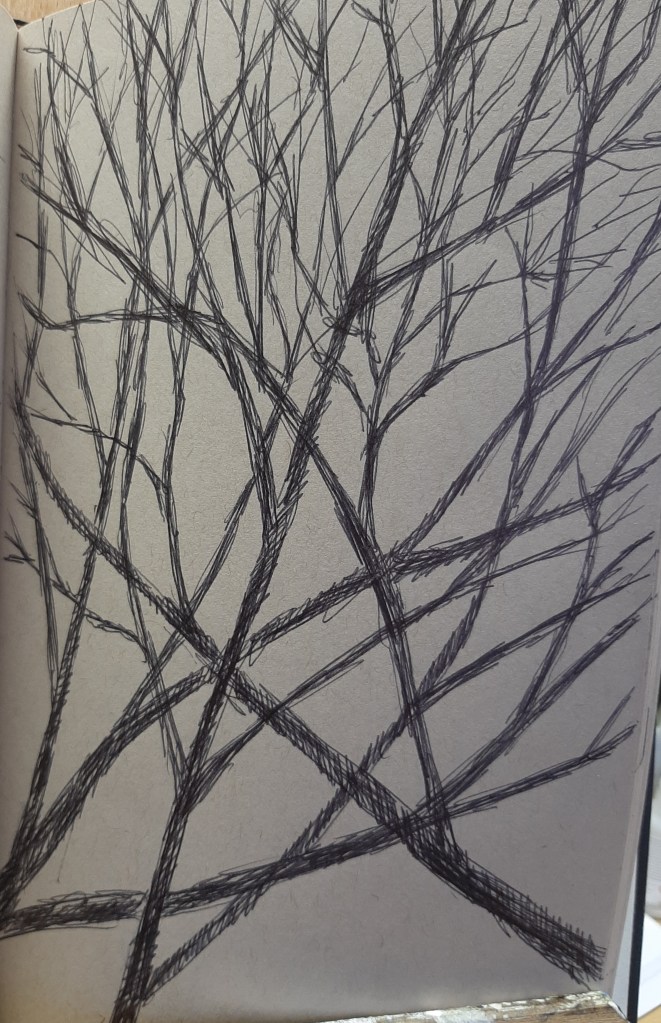
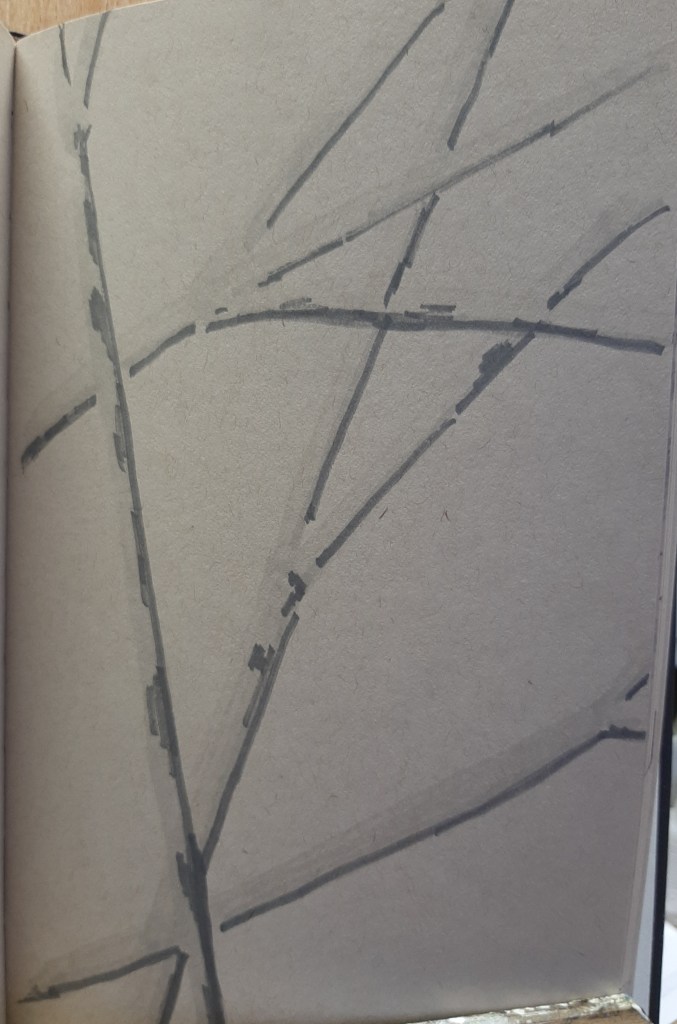
Having considered the birds activity of using found and gathered objects to build its home, I thought I could do something similar, although I was conscious of the time factor as we are limited to one hours exercise per day. I re-lived my childhood and set about making a den.


Reflection: Make notes in your log about how you felt about making changes to the ‘real world’. What were the frustrations, what were the successes? How do you think the way the viewer experiences this kind of art differs from looking at drawings framed under glass? Do you think that viewers will necessarily know what you’ve done is art?
To me, this was more of a play activity than art. I channelled my inner ten year old and engaged with an activity that was fun, and that would not damage the existing environment. I hope that what I did is found by some other children who will either play in it, modify it, or destroy it. Either way, they will engage with the work that I started. For me it was frustrating that I didn’t have more time to dedicate to the building process. It was a hasty gathering of twigs and sticks that were roughly the same length and having to break them by hand to an approximate size to fit. I enjoyed the fact that the natural v shape in the sticks lent itself to making the pieces fit together. Nature has a way of helping, rather like the way the birds have to weave their twigs together alongside the existing branches. Only in my case I was leaning the sticks against the main trunk. Not as structurally sound as the birds nest. I deliberately set the den a little bit off the path so that it has to be discovered, hopefully a pleasant reward for the keener eye. I like to wonder how many people walked past unaware, busy looking at their phones. When I consider how people will interact with this type of art rather than art that is behind glass, on a frame, hung on a wall, it is obvious that the viewer is able to interact with the piece, to fully engage with it on a physical level. This is an exciting concept. The fact that I hope some children do find it to perhaps build it further to actually engage with the process I started, and me being uncertain as to where it will go next. This is totally different to the more traditional concept of viewing art (that has been carefully prepared and presented by the artist) with your eyes and mind when it is hung on a wall in a gallery or museum.
You’ll complete your work for Part Four by undertaking a project to explore the potential of installation for drawing.
Project 3: Installation
Aim: Many artists use installative drawings and what these artists are doing positions the viewer or audience member in a totally different way to someone viewing a work on the wall contained within a frame. Using the link below, look at the work curated for On Line, an exhibition of contemporary drawing held in Edinburgh in 2010. Look particularly at the section entitled ‘line extension’ which discusses the work of Robert Rauschenberg, Cy Twombley, Ellsworth Kelly, Karel Malich, Edward Krasinski and Pierrette Bloch: https//www.moma.org/interactives/exhibitions/2010/online/ Graffiti artists are often very inventive in the way they position their works to give an extra layer of meaning or power.
Method: Make a drawing that relates to its environment in a way that creates an interesting dynamic between the artwork and the space around it. Think about ways that drawings could take part in a kind of dialogue with the space they inhabit. Text might be one way, or a drawn object in partnership with its real world equivalent. A drawing of flowers might be positioned behind a vase. A drawing might be used to ‘join up’ the view between two windows. You might be interested to find out more about trompe l’oeil or even anamorphosis – seen in Holbein’s painting The Ambassadors but also seen on football pitches and in the street art of artists like Kurt Wenner and Edgar Mueller.
Edward Krasisnski used line to extend his drawings into their environment, and used the drawn line to engage the participant in the space in a certain way. The effect is to draw the whole room, and everyone in it, into the artwork.
Holbein Research.

Holbein the younger’s 1533 painting ‘The Ambassadors’, oil on oak, 207 x 209cm, National Gallery, London is filled with hidden meaning depicting the shift in balance from the Catholic Church in England as Henry VIII was breaking from Rome and the sitters were two friends, Jean de Dinteville on the left and Georges de Selve on the right. The broken string on the Lute alludes to the fracture of the Church. The objects on the two shelves behind them depict both Worldy and Spiritual needs. The top shelf contains astrological pieces alluding to the heavens and telling time while the bottom shelf has musical items such as a Lute which is foreshortened to a diagonal plane, flutes and hymn music. A more in depth discussion of the allegory of each item in this painting is discussed in ‘Renaissance Faces – Van Eyck to Titian’ The National Gallery, London 15th October 2008 – 18th January 2009. p.116.

This principle is used today on Football, Rugby and Cricket Pitches to advertise sponsors logo’s on the pitch so that the camera in the stadium views the logo as it should be. Everyone else will see a distorted image as their viewpoint alters from the position of the camera. The anamorphosis became popular during the Renaissance almost five hundred years ago.
I felt rather inspired by Holbein’s work with the trompe l’oeil, but I do feel that the skull looks out of place on the patterned floor, not quite fitting with its environment within the rest of the context of the painting of The Ambassadors. I decided to try to draw something from within my studio area and decided on a bottle of ‘Liquin’ artists medium mainly because of the interesting shape of the bottle and the nice reddy brown colour of the liquid gel itself.
I researched the methods of calculating the perspective, and the first attempt just didn’t look at all correct, the lid was absolutely massive and I could not get it to look correct from any angle.


KEY LEARNING POINTS
This is far from easy and a sound understanding of mathematics is required for working out the perspective. It was also a challenge to work from a grid method as I have become more used to judging comparatively or using sight -size techniques for drawing objects. Having made a first attempt that failed miserably, I was surprised at the receding side on view did work quite well. I can see how this technique would be essential for pavement art and some of the larger murals that we are now seeing in City Centres – Glasgow especially. (see examples below – taken before the Covid – 19 outbreak, actually used them in my History of Art module last year).

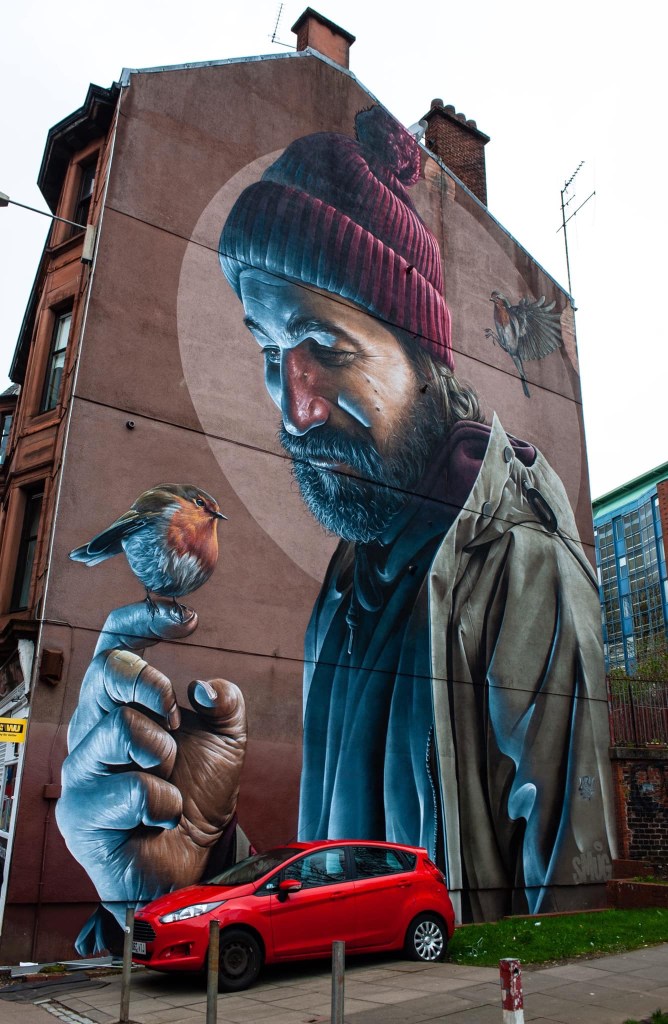

I remember visiting The Scottish National Gallery in Edinburgh to view the Beyond Caravaggio exhibition as I was desperate to view his works first hand such as ‘Supper at Emmeus’ ,1601. I was keen to examine the blending of his brushstrokes up close. I can remember my disappointment at how rough the changes in colour of the outstretched hand of the disciple falling from his chair, I also remember looking at the shape of the Christ’s face and thinking the cheeks appear too bulgy, it just didn’t look right when you were five feet in front of it. There was a plaque which stated that the painting was intended to be viewed from a distance of fifteen feet. I viewed the image again from this distance and the painting just suddenly popped into perfect clarity – the brushwork that appeared rough when up close became smooth, the facial proportions were suddenly correct, the whole painting just came to life when viewed from that distance. Caravaggio and other artists of the Renaissance were obviously aware of how to manipulate and distort images to suit a certain perspective and viewpoint.
http://www.frieze.com/issue/article/edward_krasinski/
http://www.tate.org.uk/art/artists/edward-krasinski-10009
Other examples of Edward Krasinski’s work which shows a fascination with what line could be within art whether it is performance based, or a blue line of tape that runs through a series of pieces in an exhibition to tie them together, binding them within the space of the gallery.

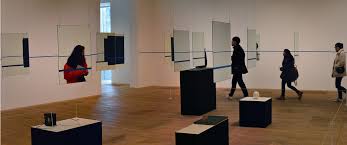
Reflection: Use the links below to find out more about Pierrette Bloch. Why is she described as using ‘poor materials’ and what do you think her materials lend to subject matter?
http://www.artcritical.com/2009/05/11/pierrette-bloch-at-haim-chanin/ This link goes to the online article in Artcriticle by Joe Fyfe, Monday 11th May 2009 which discussed the work of Pierette Bloch consisting of twined lengths of horsehair – which she likens to a combination of linear and sculptural qualities, influenced by her earlier exploration of mark making with ink on paper. In the context of comparing this with more traditional archival materials such as linen, artist grade oil paint, (lead white if you can source it in the UK), marble/wire/metal for sculpture, the use of ink and horsehair could be seen as being ‘poor materials’. However the above article defends the use of those materials as lending themselves to small spaces – a factor which she takes into account by making a miniature version in her studio in advance to prepare for the exhibition space.

http://vernissage.tv/blog/2011/01/10/pierrette-bloch-retrospective-at-galerie-kartsen-greve-paris/
To what extent would you say that this piece by Louise Bourgeois is a drawing? make notes in your learning log. (Spider, Louise Bourgeois, 1995 mixed media).

My initial reaction at seeing this piece of Art is that it is more of a sculpture than a drawing, but in the context of the image above where the Spider appears to be part of the framework of a drawing and sculpture within a cylinder inside the Spiders legs, the Spider becomes an elaborate frame. The legs themselves are linear in appearance, perhaps this could lend itself to the idea of drawing? The more I look at this piece to consider the question of to what extent could it be a drawing, the more I think it can’t be the accepted term of drawing of making a mark on a surface. For the reasons I mentioned above, it can’t be a traditional drawing, but I am looking at the cast shadows on the floor from the spindly legs and the cylinder frame which give the appearance of making marks on a surface. I am in the process of constantly challenging my views on what drawing is and what it could be. In this respect I might be less likely to see this piece as a Drawing as my mindset categorises art into genre’s like painting, sculpture, installation, traditional and modern. I fully accept that boundaries should be pushed and lines blurred, but I really struggle to see this piece as Drawing.
Contextual focus point: Emily Kame Kngwarreye
“Whole lot, that’s whole lot, Awelye (my Dreaming), Arlatyeye (pencil yam), Arkerrthe (mountain devil lizard), Ntange (grass seed), Tingu (Dreamtime pup), Ankerre (emu), Intekwe (favourite food of emus, a amall plant), Atnwerle (green bean), and Kame (yam seed). That’s what I paint, whole lot.” –
Emily Kane Kngwarreye began painting on canvas in 1988 at the age of 80 and had painted around 3,000 canvases by the time she died aged 86. Her story is an incredible one; find out about her life and work and reflect in your log on the importance of place and belonging for you in your own work. Can you think of any other artists who use place with such an immersive passion? You might also like to reflect on the relationship between painting and drawing in her work.
http://www.mca.com.au/collection/artist/kngwarreye-emily-kame
The introductory paragraph above indicates that 3000 canvases were painted over a six year period which means she was a prolific painter averaging ten paintings per week. She must have been very inspired to create such a vast body of work. Her work is certainly unique, and I was pleased that Quantas airlines decided to include her artwork on the livery of their planes.

https://www.qantas.com/travelinsider/en/trending/qantas-dreamliner-unveiled-with-livery-by-indigenous-australian-artist.html. Accessed June 2020.
The fact that a major antipodean airline company has used the artwork of an indiginous artist to help promote their company does speak highly of her dedication to her environment (which of course Quantas are using as a marketing tool).
When I think about my own inspirations for art, I think about animal portraiture, both domestic and wild which does stem from my own interest in outdoor country pursuits like fishing, walking, and other outdoor pursuits which Scotland lends itself to, along with some breathtaking scenery which has provided inspiration to artists since Victorian times when Romanticism was at its peak. I think for an artist to discover his or her voice, you need to have a sense of belonging to somewhere or something in order to project that emotion, that energy, that unique perspective from that part of the World to the viewer. For me, this comes from a love of nature, its shapes, colours, animals, texture (fur and feathers as well as foliage). I am also becoming increasingly attracted to portraiture, and I try to capture that ‘uniqueness’ that we all have in my sitter (or myself). Because of this I believe that every artist is invested in their own belonging and place. Constable painted his beloved English countryside, Scottish contemporary colourist Scott Naismith is fascinated with the colours provided by sunrise and sunset in the Western Isles and paints seascapes and landscapes almost exclusively. Many of the Post Impressionists sought the unique light and colours provided in the South of France. The Impressionists themselves depicted life in and around Paris, The Glasgow Boys explored the Scottish countryside and developed the trend to paint en plein air, away from the studio in the late nineteenth century (the development of tubes for oil paints greatly helped this process!), contemporary artist Christian Hook finds inspiration from the horses of the South of Spain – he is a native of Gibraltar. While these artists don’t have the same prolific output that Emily Kame Kngwarreye had, they share that sense of belonging to something bigger which provides inspiration. When I look at examples of Emily’s work, I was struck first of all by the size of many of her pieces, many are pretty big, but her own style of painting is very much a ‘drawing’ style in that the marks are bold, almost like cave drawings, and with a similarity to Jackson Pollock’s paintings – who was influenced by sand paintings in America.
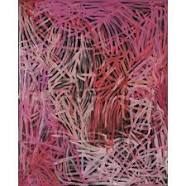
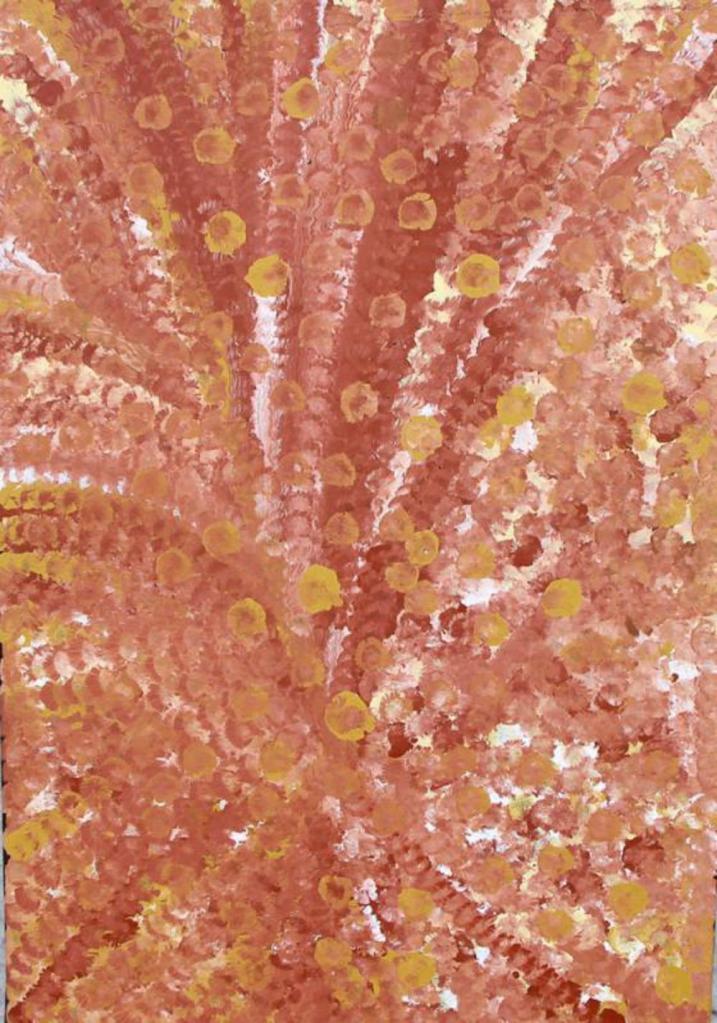
From the example above, it is my opinion that the bold use of lines is more of a drawing style, although it is completed with paint. The lines are solid, the colours rarely blend so retain their vibrancy. The image below which shares the same name ‘Yam Dreaming’ shows a different approach – I suspect her fingers applied the paint directly. There is a definite feel of a plant in this painting, so the connection with nature is being transferred through the paint onto the canvas.
The parallel Project and Critical Review
Now that you’re nearing the end of Drawing 2: Investigating Drawing you should be making significant progress with both your parallel project and critical review.
Parallel project: You should by now have a body of contextual research to draw on and a significant amount of experimental work in your sketchbooks. You should also have a clearer idea of the form that your final work will take. Will you produce a single piece or a body of work? If the latter, how will you link the individual pieces? What materials will you use for your final piece(s)? How will you present your work to your tutor and the course assessors?
Critical review: You should by now have gathered together your sources for this written project (suitably referenced) and have submitted a final plan or outline to your tutor for their comments. If you’ve started writing, it’s a good idea to send your first draft to your tutor so that they can check that you’re working along the right lines, especially if you haven’t attempted a piece like this before.
Assignment four
Find a place of significance to you to create a site-specific artwork. Responding to features of the site, add a drawn element or select a found drawn element which you’ll extend to express something you find interesting about the site. Relate your art work to your research in your log and synthesise what you’ve learned about installative and environmental art with your own interests.
For this assignment, you may have to submit a photograph of your final piece. If so, make sure that this is of an adequate scale and quality for your tutor to gain a true impression of your work.
After a number of considerations about which direction this work should take between the abstract shapes of nature, or the use of anamorphic perspective in a drawing, and how a drawing can interact with its environment. The Covid-19 pandemic has meant that we are unable to leave our home environment. The research into Krasinski’s work has given me a new perspective about how bodies of work can be attached (a simple blue line in this case), as well as examples of pavement art to entertain passers by. I began looking at areas around my home, and having considered my studio as a potential area, it seemed a bit too obvious so I discussed the ideas with my family and my son has always been a fan of James Bond and loves Aston Martin cars, and the idea just materialised right there that I could make a drawing of an Aston Martin appear as if it was inside the garage on the garage door. I started by finding a suitable image, I then measured the size of the garage (standard 6.5 ft x 7 ft), and made a scale drawing on a piece of A3 paper which was gridded.


I began by scaling up the grid to fit the garage door and painted the outline and filled it in in the course of one day. It was a challenge to work on a large scale, but using large brushes helped, although this made the fine detail a bit challenging.

Send to your tutor:
- your final piece (see above) together with any preparatory work
- a short reflective account (up to 500 words) outlining your experience of this assignment
- a representative sample of your work from the projects in Part Four, including relevant pages from your sketchbook and learning log (or send your blog url)
- your response to the contextual focus point (Emily Kame Kngwarreye)
If you haven’t done so recently, don’t forget to give your tutor a progress report on your work for the parallel project and critical review.
Reflection
Take a good hard look at the assessment criteria in the introduction and make sure that your work meets the standards set. Ask your tutor whether they think you will be ready for assessment at the end of the course and what you need to improve upon.
This assignment was more fun and interesting than I had expected it would be. Despite the difficulties presented by the Covid-19 pandemic which limited movement from the local area making some exercises a bit tricky to engage with. Before starting this assignment my views on drawing were leaning more towards the traditional classical side using tried and tested mediums such as graphite, charcoal and ink. Project 2 was a great chance to use natural objects and really step out of my comfort zone where I used some sticks to build a den around a tree trunk. The idea that only natural objects were used in a way that interacted with its environment, and there was the possibility that other people could then interact further – possibly destroy it or build it further – was exciting. Previously my relationship with the viewer was limited to them looking at my work, not interacting with it.
For Project 3 I became interested in the anamorphic perspective using Holbein’s painting ‘The Ambassadors’ as a starting point where I tried to emulate the skull coming into view from a certain viewpoint, but using an object that made sense with its environment. I think the skull looks odd on the floor in Holbein’s work. I had a few attempts where I struggled to get the object (a bottle of Liquin oil painting medium) to look real. The first drawings had caps that were massive, causing a viewpoint from directly above, but the cap looked so large it was larger than life size. I tried a sideways perspective which did work a little bit better. I enjoyed doing the research into some pavement chalk art and the idea that you can trick people’s minds and perception of objects. Again this is challenging the traditional viewpoint of drawing on paper, so it was good to challenge my own views and experiment in new ways.
With Project 4 I developed the idea of challenging myself a bit more with the artist in residence day at Cass Art in Glasgow where I did an ‘alla prima’ portrait of one of Rembrandt’s self-portrait etchings. This was carried out in March just before the lockdown rules were enforced. It was strange painting live in an art store, answering questions and talking about my process. Time-lapse video on my blog.
Thinking about the pavement art and making subjects interact with their environment and challenging my own traditional views on drawing surfaces and materials, it only seemed fitting that I should paint an Aston Martin in the garage, as if the garage door was open and the car within as my final assignment piece.
I now consider ‘drawing’ in a much wider scope than before. The art of Emily Kane Kngwarreye was interesting to ask what inspires me from a place of belonging, it’s interesting to start comparing yourself as an artist with other great masters and find something in common.
(word count 497 ).
Make sure that all work you send to your tutor is clearly labelled with your name, student number and the project or assignment number. scan or photograph any supporting work and/or the relevant pages of your learning log. These can be summarised as a pdf document, uploaded to your blog or organised and submitted by post.
Images
Hans Holbein the Younger, The Ambassadors, 1533, oil on oak, 207 x 209.5cm, The National Gallery, London. https://artsandculture.google.com/asset/the-ambassadors/bQEWbLB26MG1LA?utm_source=google&utm_medium=kp&hl=en-GB&avm=2 Accessed May 2020.
Sources
Lorne Campbell, Miguel Falomir, Jennifer Fletcher and Luke Syson, 2008-09, ‘Renaissance Faces Van Eyck to Titian’, National Gallery Company, London, Yale University Press.
Krasinski 1969, https://www.google.co.uk/url?sa=i&url=http%3A%2F%2F1995-2015.undo.net%2Fit%2Fevento%2F38436&psig=AOvVaw02kaL0MsSDZnIvTsikkm9b&ust=1589893191096000&source=images&cd=vfe&ved=0CAIQjRxqFwoTCOCJz4e8vekCFQAAAAAdAAAAABAF accessed May 2020.
Edward Krasinski, Tate Gallery, https://www.google.co.uk/imgres?imgurl=https%3A%2F%2Flive.staticflickr.com%2F7850%2F40520783083_13a44efd4a_b.jpg&imgrefurl=https%3A%2F%2Fwww.flickr.com%2Fphotos%2F40139809%40N00%2F40520783083&tbnid=BQlIdVfB7bL2DM&vet=12ahUKEwiU9q3ou73pAhUQahoKHbkUCw8QMygSegUIARD5AQ..i&docid=NahyZ_Ok6slfoM&w=1024&h=429&q=krasinski%20art&safe=strict&ved=2ahUKEwiU9q3ou73pAhUQahoKHbkUCw8QMygSegUIARD5AQ Accessed May 2020.
 Neil C Drawing 2
