Project 1 : Drawing Blind
Aim: This project should make you very aware of how your brain works when you’re drawing – by changing the sense that you’re translating into physical movement from sight to touch. As you’ll see, translating the visual processing of three dimensions into a physical movement designed to leave a trace on two dimensions, which in turn may give the illusion of three dimensions, is a highly sophisticated process.
Method: Choose a smallish object you know well, preferably something with a fairly distinctive shape. Position it on a table with a sketchpad next to it. Put your pencil in the middle of your sketchpad then close your eyes. Reach for your object and feel it, as you do this, make a record of what you feel on your sketchpad with your pencil. Feel free to take a peek and reposition your pencil at any time, but do this as little as possible. Make several studies until you feel that you’ve arrived at something interesting.
For this exercise I chose a multi headed screwdriver as I thought it was a fairly distinctive shape. Rather than using a pencil I decided to use a pen to record the actual marks I made and not be able to erase them.
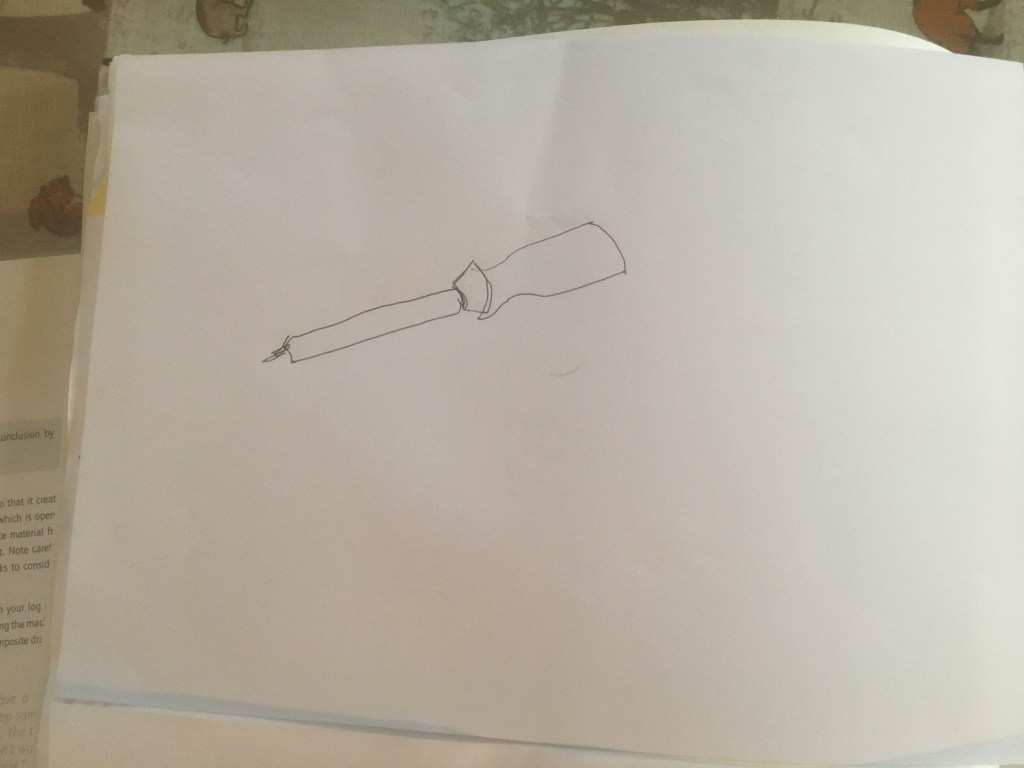
When drawing this I was amazed at how much smaller I made the drawing. My eyes were closed the whole time and I used my left hand to constantly touch and feel along the shape. As my finger moved along the shape, I replicated what I felt through sense of touch and tried to replicate this through the pen in my right hand. When you stop to think how much you depend on your eyesight to actually see in order to translate a 3D image from your eyes and brain and translate this onto a 2D surface and make it appear 3D – which is a very complex process in itself! – and I was pleasantly surprised that the end image was recognisable as a screwdriver, but I was really surprised to see that what I drew on the paper was one third the size of the actual object. That was a real shock so I did another attempt but making a conscious effort to make the drawing bigger.
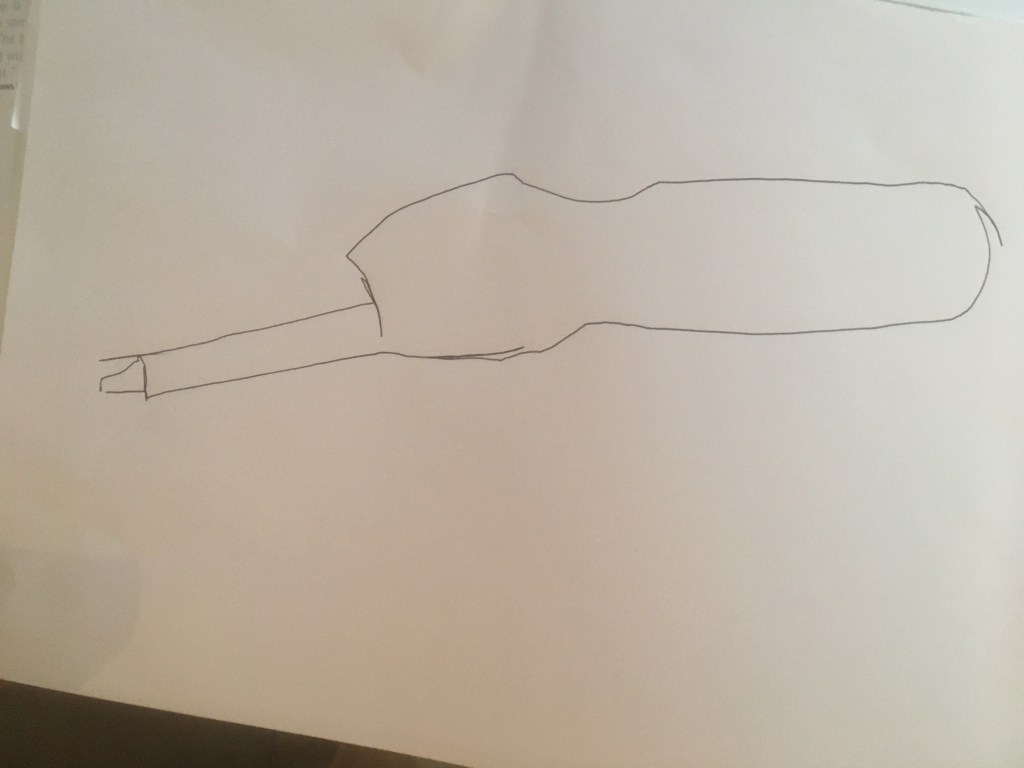
The handle was slightly enlarged, but a better representation of shape, and I lost the angle of the shaft, although it is still clear that it is a screwdriver. I can see the benefit of repetition with this exercise.

The final outcome was an improvement taking what I learnt from the first two attempts. I was pleasantly surprised at how quickly I was adapting to drawing without using my eyes and still achieve a recognisable outcome. The object is rather more simplistic than I would have done had I used my eyes and searched for more detail and representation. However I am pleased with the result and I did note that I had to concentrate a lot more, it was like learning to walk again.
Reflection: How far were you recording the sensation and the act of touching, and how far were you trying to use touch as a replacement for sight?
As noted above, the act of touching was replacing my eyesight and I really struggled by having to concentrate on visualising what I was seeing by touching. I was reminded of John Singer Sargent being horrified at the thought of losing his eyesight as he depended on it as an artist and was inspired to paint ‘Gassed’ in 1919 which depicted a line of wounded soldiers making their way back to a dressing unit. In order to embrace the exercise I relied totally on trying to visualise through my fingers and I concentrated on visualising the marks that the pen was making. The pen was also used in order to avoid the temptation of rubbing out and starting again, I wanted to see the actual marks that I made without my eyesight.
LEARNING POINTS
Recognisable images can be produced without being completely accurate. Take it for granted just how much we rely on our eyes, surprised at how it can be replaced through touch (albeit with consciously incompetent results!).
Project 2 : Experiments with mark-making
Aim: This project continues the theme of focusing attention on your own physicality and opening up your method to new ways of moving.
Method: Set up a reasonably large still life, for example two or three chairs piled together. Make yourself some drawing tools by attaching pencils or pieces of charcoal to the ends of bamboo canes or similar. Place a large sheet of paper on the floor and try to draw your subject using these super-elongated pencils. You’ll have less control but you may find that little movements you make have big results as they are magnified by the canes. This will lead to a very sensitive responsive mark. Even if you struggle to get an accurate representation of your subject, you’ll have a super-accurate representation of your own struggle!

I tied a piece of charcoal to the end of a section of a fishing-rod, I like the comfort of the cork handle. Obviously tight control was not an option, but there is still a feeling of representation. As anticipated from the notes, slight movements are amplified by the long handle. Small gestural marks were amplified. It was quite straight forward to start making marks with the charcoal although it did feel strange being as far away from the paper.

LEARNING OUTCOMES
It was a fun method as long as you are not trying for a ‘finished’ outcome with fine detail, there were elements of representation such as the bowl. This method emphasises some gestural marks due to the effect of the extended baton which amplifies the mark on the paper from your hand movement – (think proportion calipers). It was good to be removed from the paper as being too close can prevent proper observation. This was a bit like the classical ‘sight size technique’ as taught in academies and ateliers across the world. This gestural approach could be effective for a quick sketch before refining detail, it also serves to capture the essence of the subject.
I believe this could be an effective method for an abstract portrait that captures the essence of the sitter without capturing too much detail.
As a second stage, if you’d like to add colour to this drawing, grab a handful of wax crayons, pastels or pens for each colour, for a blue jug, for example, pick up half a dozen different blues, greys and lilacs, hold them in your fist and draw with them all at the same time. This will give a woven effect which can be built up to achieve quite subtle effects.
Reflection: What happens when you break the relationship between your brain and the marks you make in this way? Are these simply bad drawings – or do they point the way to a kind of responsiveness within the act of mark-making which enables a more sensitive and ultimately more informative line? This is a loaded question, but respond with your own views and reflections based on what you’ve learned so far.
Having expected not to produce a tight drawing before starting the exercise, my mind was already open to see what results just happened. I was pleasantly surprised at how quickly the still life came together as a recognisable object(s), the charcoal was quite hard and left light marks, so building shadow was quite hard as this necessitated repeated marks in the same area which was hard to do being so far away. This distance helped me to see the drawing in a similar way to how I was seeing the subject – kind of like ‘sight size technique’. Where a gestural mark was captured correctly it looked really effective and produced an interesting outcome where the expression of the artist seems to come through rather than artistic talent (although artistic talent will help to make correct gestural marks in the first instance!). Having used a ‘baton’ with charcoal before, I was aware of the importance of being further back from the drawing but not quite this far back!! I was pleasantly surprised at the gestural marks that this exercise created and feel that this could be explored further to create more interesting work.
Research point
“The Abstract Expressionists’ use of gesture was caught up with notions of authenticity and even of purity of intent. The influential critic Clement Greenberg wrote in his article ‘Avant garde and Kitsch’ in 1939 about the good artist painting ’cause; and the bad artist painting ‘effect’. He also talks about what he describes as ‘the inflections of the personal’ becoming a legitimate subject. For example, the artist Jackson Pollock talked about wanting to paint from his emotions, not to illustrate them. What’s your response to these comments?
You can find out more about Jackson Pollock by watching this video, an influential contemporary film made by Hans Namuth: https//www.youtube.com/watch/v=6BvpjwOGo
Arguably, Pollock is best known for the paintings initiated by pouring or dripping paint onto the canvas rather than applying it directly. The next project asks you to experiment with drawing ‘at one remove’ by using an object to make marks.
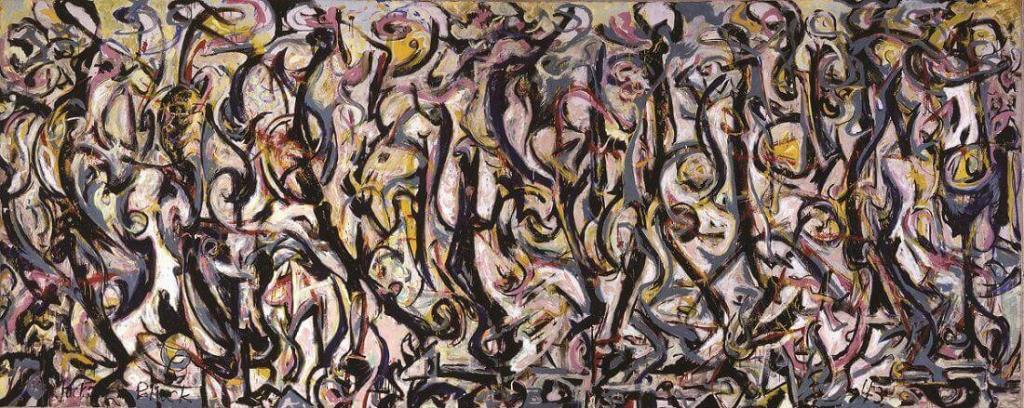
I have always been intrigued by Jackson Pollock’s work and his method because it was so radical from every other art movement and artist before him. I knew that the Abstract Expressionist movement came about as a means of resisiting the ‘dumbing down’ of culture caused by consumerism and was led by artists like Picasso, Braque, and Kadinsky as championed by Greenberg in the 1939 Partisan Review article where ‘Avant Garde and Kitsch’ (Kitsch is the German word for trash), and where there is an Avant Garde, there must also be an inferior rear-guard which was the increasingly popular Abstract Expressionism, this ‘Kitsch’ work gradually became ‘Avant Garde’ (as documented in Honour and Fleming (2009) through Pollock’s work – see 1956 article in Life magazine where he earned the nickname ‘Jack the dripper’ and Time magazine ‘Art: The Wild Ones’ (link below). Whilst I struggle to understand what people actually see in Pollock’s work (or is it what they think they see?) because to me it looks like what it is, paint dripped and splattered on a canvas albeit with energy and a certain methodology. Before looking at the Hans Namuth 1951 interview where Pollock showed his method I had only seen his work in books and I am aware that some of these large canvases might be more impressive when viewed directly – I experienced this when looking at Caravaggio’s work when the ‘Beyond Caravaggio’ exhibition was shown in Edinburgh in 2017 as I had only seen ‘Supper at Emmeus’ 1601 in books and online, but the painting had a far more moving and profound experience when viewed directly. Perhaps it’s fair to assume that Abstract Expressionist works can be the same. I was aware that Pollock was not particularly gifted at drawing in the classical manner – as he admitted his two years of study in New York with the Art Student’s League under Tom Fenton, of whom he said “Was a strong personality to react against”, indicating that the two often butted heads. It was very interesting to see that Pollock was very concerned with the methodology of his paint dripping technique, that he actually was trying to control the effects of the paint splattering and dripping through controlled movements that he felt were necessary was a real insight to me. I found the following monologue from Pollock in the Namuth interview to be particularly enlightening where he describes his methodology which has obviously gone through trial and error and Pollock is searching for something in his use of the paint. “I don’t work from drawing or colour sketches. My painting is direct, I usually paint on the floor. I feel nearer the canvas. This way I can walk around it, work from all four sides and be in the painting similar to the Indian sand painters of the West. Sometimes I use a brush, but often I prefer using a stick. Sometimes I pour the paint straight out of the can. I like to use a dripping, fluid paint. I also use sand, broken glass, pebbles, string, nails or other foreign matter. The method of painting has a notion grown out of a need. I want to express my feelings rather than illustrate them. The technique is just a means of arriving at a statement.”
This statement provides a rich insight into Pollock’s beliefs and what he is searching for as an artist, he doesn’t want to control the paint by guiding it with a brush, or depicting tonal values to describe a form, he is letting the paint arrive at its own statement through his own expressive movements. He also stated that he has no fear of changes or destroying the image, its almost as if he accepts this as the outcome – “The painting has a life of it’s own, I try to let it live”. This throws significant light on what Pollock was driving towards and I can understand his work a bit better now. The exercises in assignment three are more relevant and I understand where I can try to show my emotions through gesture, line and tone rather than producing a finished work.
As a follow up to the first video, I watched another BBC documentary hosted by Melvynn Brag where Pollock’s friends and family were interviewed and a great insight into his troubled life which threw a light on the reason he perhaps felt the need to express his emotions through paint and action. It is always interesting to see first-hand reviews of contemporaries to compare alongside the artists own view of himself.
Watching these interviews before finally writing the research did help me to engage more with the exercises in assignment three and I do feel that I have gained more out of this simply by having a better understanding of what drove Jackson Pollock and I can understand that art is not just about reproducing a subject accurately, that emotion can actually enhance artistic skill and creativity. Pollock was searching to use paint through dripping and motion with his own unique methods just as realistic or representational artists search to find representation through the use of technique, tone, and hue.
Fig.1. Mural, 1943.
Sources
Time magazine, 1956, ‘Art: The Wild Ones’
file:///C:/Users/User/AppData/Local/Microsoft/Windows/INetCache/Content.Outlook/17JWTO60/Art_-The-Wild-Ones-Printout-TIME.pdf
Accessed 5th January 2020.
Hans Namuth Interview 1951- YouTube, https://www.youtube.com/watch?v=NQQ36kojicg Accessed 5th January 2020.
BBC 1987 Melvyn Bragg documentary, http://www.openculture.com/2012/12/a_portrait_of_jackson_pollock_presented_by_melvyn_bragg_1987.htmlC, Accessed 5th January 2020.
Honour and Fleming, 2009, 7th edition, A World History of Art, Laurence King Publishing, London and New York.
Project 3: Drawing ‘machines’
Aim: Push the concept of marks as a tracery of movement to its equal conclusion by making marks incidental to your own movement.
Method: Find something which moves and attach a drawing movement to it so that it creates a drawing by itself. You might use a remote control car, a clock face, a door which is opened regularly, the foot of a dancer. Develop these automatic drawings using source material from your sketchbook or simply by responding to what you find as you experiment. Note carefully what happens when you shift the drawing from automatically produced marks to considered ones.
I decided to use the kitchen door as it describes an arc (and was the only door in the house that my sketchbook would fit under!!), and I asked my wife to rotate my sketchbook randomly and make some marks with the pen by opening and closing the door.
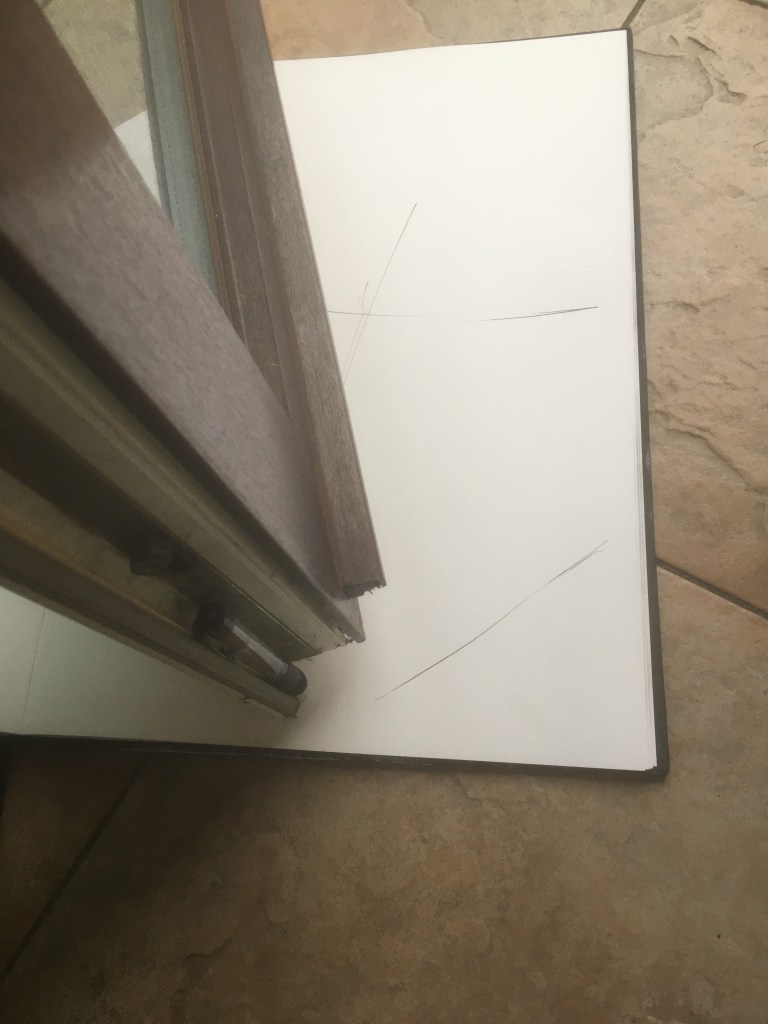
As I was using my sketchbook that contains a mixture of assignment work and parallel project work where I was researching portraiture and two things struck me straight away. First of all, the lines were roughly similar to the way I would prepare a portrait (probably due to the parallel project exercises) and Rembrandt’s etchings and portraits have featured in my sketchbook so it seemed natural to see this pose of Rembrandt emerge. I was using drawing pencils so that the original automated marks would remain visible.
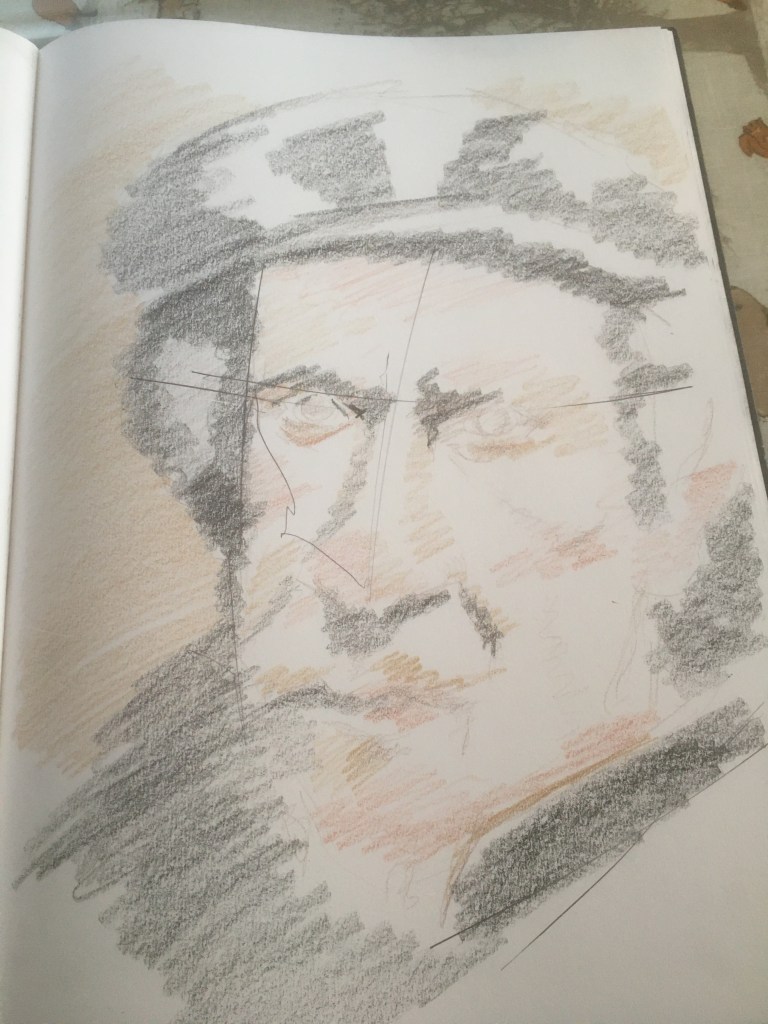
I was very pleasantly surprised at how well this portrait fitted in to the initial automated marks. The likeness was emerging very quickly.
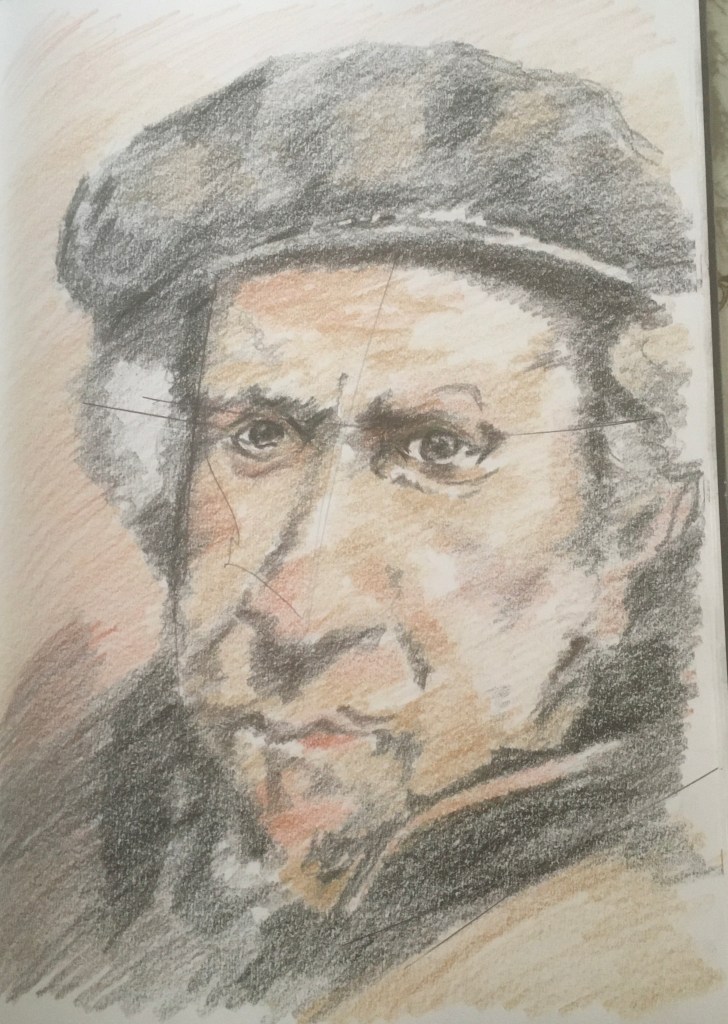
Final outcome here is a copy of one of Rembrandt’s best known self-portraits. I did feel it was important to be able to retain the initial automated marks and that was why I used pencil over the ink.
LEARNING OUTCOME
Inspiration to produce a finished outcome came from purely random marks. My brain filled in the blanks when I saw the initial marks and asked myself what could those marks turn into and looked through my sketchbook for inspiration. I have been drawing a lot of portraits and I use a method similar to the Loomis method of gestural marks and proportion before adding details. It was good to see the idea form from other work rather than one idea go from start to finish, it was one idea morphing into another. This could be an important learning curve to always be aware of what else a piece of work could be.
Reflection: Research Rebecca Horn’s drawing machines and make notes in your log about them. What do you think Rebecca Horn was trying to find out or express by making the machines? How does the element of control affect the feel of the drawing? In your own composite drawings, which marks do you prefer and why?
Research Point
Project 3: Drawing ‘machines’ Rebecca Horn.
I was very interested in Rebecca’s process stemming from her early bed ridden illness from exposure to fumes from fibre class materials which forced her to explore possibilities of extending her arm and expressing her feelings of isolation. Her ‘Peacock’ piece took over the idea of human expression, gradually the machinery began to take over as part of the process of her installation art – see the ‘Activation Real Time’ YouTube video to see how removed from the process she has become.
I read the Guardian article ‘The Bionic Woman’ by Jeanette Winterton in 2005 and was very interested to understand how Rebecca views her machines. Before reading the article my own view about this performance installation art is that I feel awkward about a machine’s ‘action’ producing art. I understand the abstract expressionism of Jackson Pollock where I understand the idea that the action is the art, that the artist himself felt the need to be able to approach the flat canvas from all four sides doing an action that he was still able to control via dripping and pouring technique. This search for a purity of intent seems to halt and falter in my mind when the machinery takes over, it loses its human touch. That said, in the Guardian article Rebecca Horn talks about the machines as if they are human, that they have emotion and feelings, “I like my machines to tire”, “They are more than objects. These are not cars or washing machines. They rest, they reflect, they wait.” These are obviously human traits which seem to justify her exploration from body extensions.
The ’Activation Real Time’ YouTube video shows a machine repetitively spraying a pattern of ink in a horizontal left to right movement on a vertical piece of paper on a wall, the machine moves up and down (randomly?) to create different lines which then drip and run into each other. There is a combination of control and randomness in this work. The control comes from broadly similar marks created by exact left to right from the machine spraying a measured amount of ink/paint which produce broadly similar marks time after time. The randomness happens as the downward runs form on the paper and merge into each other and lighten in tone as the content of the ink/paint dissipates in its downward descent. I see an obvious parallel with Jackson Pollock’s dripping technique, except for me Pollock was trying to control the drips and pours to produce an outcome, whereas Horn is absent from the process and because of this I find that her work lacks a human touch. From her own views about the machines having feelings and emotions – a view repeated in ‘The Bastille Interviews II: Paris 1993’, where she speaks about the tragic and melancholic aspects of machines being important to her work this leads me to believe that she is searching for the machinery to express emotion. I find this hard to believe as humans have the ability to express emotions through intentionally making hard or light marks in specific places, using bold or thin lines to convey the emotion they are feeling, machinery cannot do this in my own opinion and this is where I struggle with Horn’s Drawing machines, the belief that a machine has a soul will not alter the mark that it makes.
For this reason I believe that the element of control is significant in artistic work (even if the artist is slightly removed as in the case of the self portrait I did with a piece of charcoal tied to the end of a section of a fishing rod, there was still a likeness with abstract qualities). Where this is limited to automated, regular movements the artist cannot possibly claim to have any control or emotion. In my own work I prefer the marks where I have control over marks that were outwith my control, this is just my own preference. I can see the value in automated marks as being a starting point for me to produce a piece of art with emotion.
Rebecca Horn, Guardian article, ‘The Bionic Woman’ Art and design, 23rd May 2005, Jeanette Winterton https://www.theguardian.com/artanddesign/2005/may/23/art
Rebecca Horn, ‘Activation Real Time’ YouTube video https://www.youtube.com/watch?v=RftVz89dKJ8 accessed December 2019.
Project 4: An emotional response
Aim: This project is in some ways the antithesis of the previous one. Last time, you used an object to draw ‘for’ you; this time you’ll allow your own emotional responses to direct your physical mark-making.
Method: Take 10 pieces of card and give them to friends. Ask them to write down a characteristic of someone in a novel or newspaper article in the first person. Ask them to choose something which might engender an emotional or physical response. Examples might be ‘I killed 15 women’ or ‘I won the lottery’ or ‘I feel nervous at parties’.
Ask someone to sit for you as a model. Every 10 minutes ask them to read from one of the cards. As they read the statement out, try to change the way you use the materials to respond to the statement. Make angry, scared, joyful marks as prompted.
You can write the statements yourself if you prefer but it’s important not to write anything which might be construed as a comment on the model. Make sure they are all fictional attributes, the more fantastic the better.
If you don’t have access to a model, make a self portrait or simply imbue another object – a chair, perhaps – with these qualities.
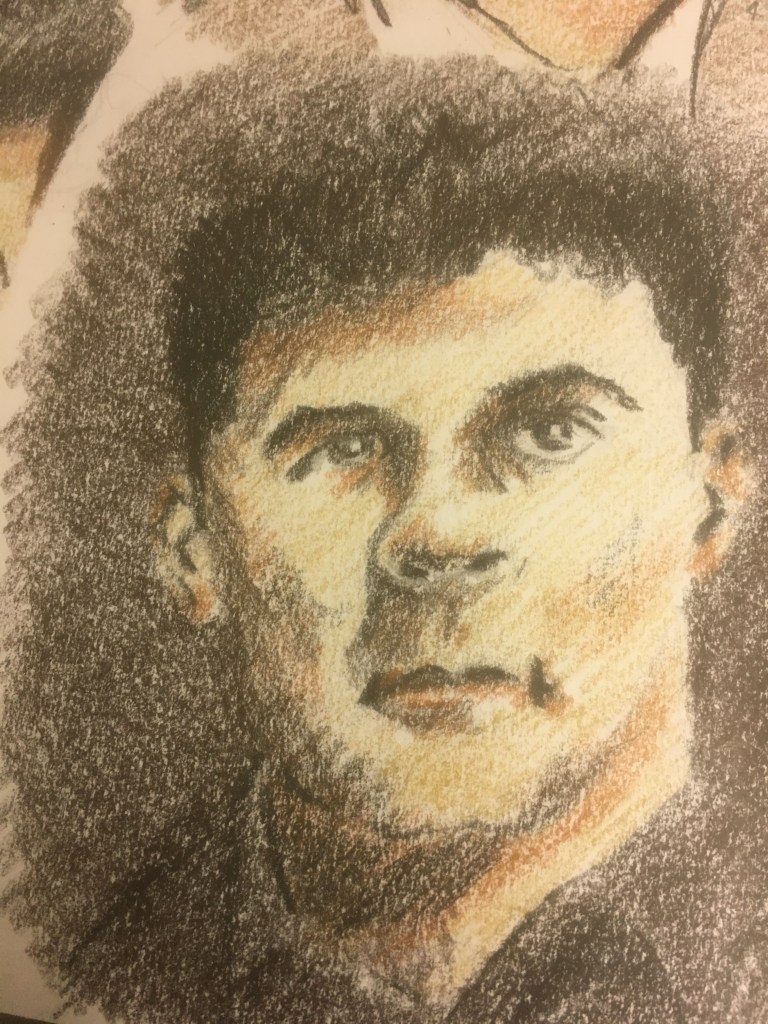
For this project it was a real joy to be able to use my own son as a model, he is a successful actor and loves making facial expressions, so when I read out the emotional prompts, he made a change to his expression which I tried to capture. In order to maintain a level playing field for the purpose of the exercise I used the same range of drawing pencils for each portrait to see how the way I handled the same medium changed as my own mood or expression changed. I also felt it was important not to use an eraser as I was not looking for a perfect likeness, I was searching for emotion and expression to come through. Here are the results.


REFLECTION AND LEARNING OUTCOMES.
Reflection: Make some notes in response to this exercise. To what extent did your emotional and physical responses fuse? For example, you may have found that to start with you felt an emotional response to the statement and then translated this into a physical response in your mark-making. Did this change as you progressed with the exercise? Did you find yourself able to respond emotionally and physically at one and the same time? You’ll pursue this idea further for your next assignment when you’ll make marks in response to music.
Reflecting on the above exercise, it is abundantly clear that the way in which I used the materials did indeed reflect my own emotional response ( as well as Jordan’s own interpretation with his change of expression in response to each emotional prompt). For example the first one, Anger, has a bold and heavy linear quality while the Sympathy has a softer and more subtle use of tones. Also the examples of Happy which has a far lighter use of colour than the strong darks and chiaroscuro in Fear so it is clear that my own emotional responses were coming through. A problem that I faced with this is that I do find the act of Drawing to be pleasurable ( especially when you capture the eye expression with a single mark!) so if I started trying to get my mindset in a dark gloomy place to reflect Fear or Sadness, the act of drawing the portrait began to cheer me up and my own mood changed to a happier one and I had to remind myself of what my own emotional state was supposed to be. Other than that, this was a most enjoyable exercise and I can clearly see the benefits that the self portraits in the parallel personal project are bringing as I see my own portraiture abilities improving with the use of a live model.
Contextual focus point: Erased De Kooning
In 1953, Robert Rauschenberg asked Willem De Kooning for one of his drawings. Amazingly, he agreed. Rauschenberg then proceeded to rub out De Kooning’s drawing and exhibit the resulting near blank sheet. This is such a beautiful moment in art history as it brings together the mood of the time and the lasting legacy of both Abstract Expressionism and what would later become post modernism. Find a reproduction of this drawing on the web and make notes on how you feel about it at first sight. Then look a little into the background and try to get an understanding of why Rauschenberg might have done this. There are video interviews online with both artists. Use Google to find the videos and make notes on your thoughts about what happened.
Contextual Focus Point: Erased De Kooning
“In 1953, Robert Rauschenberg asked Willem De Kooning for one of his drawings. Amazingly, he agreed. Rauschenberg then proceeded to rub out De Kooning’s drawing and exhibit the resulting near blank sheet. This is such a beautiful moment in Art History as it brings together the mood of the time and the lasting legacy of both Abstract Expressionism and what would later become Post Modernism. Find a reproduction of this drawing on the web and make notes on how you feel about it at first sight. Then look a little into the background and try to get an understanding of why Rauschenberg might have done this. There are video interviews online with both artists. Use Google to find the videos and make notes on your thoughts about what happened.”
I managed to find an online image of the Erased De Kooning by Robert Rauschenberg in 1953. (Fig.1).

My initial thoughts about the work were of shock and dismay that another artist would have the audacity to deface another artists work for their own notoriety. I thought it was a stunt in bad taste and the only possible reason I could see for wanting to erase another artists work would be from jealousy.
In order to try to get a better understanding of Rauschenberg’s motives I began by looking at ‘World History of Art’, 2009, 7th edition, Honour and Fleming, and examined the main cultural and political influences on society at this time. Twenty years earlier, many artists, poets, musicians and scientists sought to escape from the threat of Nazi Germany in Europe and moved to the sanctuary of the USA and New York was the new artistic hub of the World taking the title from Paris and with that move came a change in artistic values aided by critic Clement Greenberg where traditional values such as academic training and the end outcome became less important than the artistic expression and or movement – as per Pollock and Rothko. Artists were now seeking to break free from traditional representation to consider expression and gestural movements.
This new artistic freedom came from following the pioneering ideas by Duchamps – ‘Readymades’, Rauschenberg was seeking to push the boundaries of what art was/could be. He wanted to explore if a piece of art could be constructed through erasure ( William Kentridge certainly uses this property in charcoal with his filming works as I discovered in Assignment 1), and it is interesting to note that Rauschenberg did try erasing his own works first, but this did not have the same impact, he had to erase something that was already culturally significant. This is the reason that the simple plaque at the foot of the drawing is there, otherwise how would the viewer be able to place the original cultural significance of it being a De Kooning Drawing? Without the plaque it could be any drawing and would therefore be of less artistic value. This erasing procedure does entirely fit with Rauschenberg as it is consistent with his method in other works such as ‘Bed’ where he smeared paint on the sheets and the bed and placed it upright against a wall – (WHA p.844), or where he combined painting with photographs or objects. Rauschenberg was seeking to push the boundaries of drawing. Part of me wonders if this moment could have signified Rauschenberg simply passing comment on movements within Art History, one movement supercedes another by rebelling against its values.
Modernism and Formalism, the following quote from Honour and Fleming (2009) gives a good insight into the artistic motivations of the period. “As for Baudelaire in the mid-nineteenth Century (see page 670), the experience of modernity was the defining challenge.
The need felt by artists to be ‘of their own time’ led to an approach that stressed innovation above all, an impulse to seek new solutions to pictorial and sculptural problems. Engagement with contemporary themes and contemporary culture was felt to be essential for a ‘modern’ artist…..” (WHA p.844).
I watched a YouTube video where Rauschenberg was interviewed specifically about this and was interested in his answers and insight. The fact that he was nervous about approaching De Kooning about this idea and had to bring a bottle of Jack Daniels for the occasion tells us he realised he was asking a lot and that he was surprised when De Kooning (reluctantly) agreed to the idea as he understood the importance of the erasure of a significant work. Because of his reluctance, De Kooning didn’t make life easy for Rauschenberg as he provided a piece that had oil paint, charcoal and crayon on it which took Rauschenberg an entire month to erase.
Doing the research on the piece has improved my understanding of what Rauschenberg was trying to achieve – pushing the boundaries of Drawing, and why it couldn’t be his own work, it had to be a piece of cultural significance – a De Kooning. And this is consistent with Rauschenberg’s artistic process that he used in other works. My own reasons for not agreeing with the concept have been diminished. Prior to this I was accepting of the idea that a drawing could be created with a subtractive method – especially with mediums like charcoal.
Sources
Fig.1. Rauschenberg Erased De Kooning image 1953. https://www.google.com/search?q=rauschenberg+erased+de+kooning+drawing&safe=strict&tbm=isch&source=iu&ictx=1&fir=HKfHhxyvz0IJzM%253A%252CXysFMSj2fxkM9M%252C%252Fm%252F03q6_74&vet=1&usg=AI4_-kQE-YE_ZwlzcXgZ_CaG964Fa0_A7Q&sa=X&ved=2ahUKEwj8ucTGgNTmAhXST8AKHdHIDfgQ_B0wE3oECAoQAw#imgrc=HKfHhxyvz0IJzM: Accessed 26th December 2019.
World History of Art, revised 7th edition, 2009,Hugh Honour and John Fleming, Laurence King Publishing, London.
Rauschenberg Interview Erased De Kooning 1953 YouTube. https://www.youtube.com/watch?v=tpCWh3IFtDQ Accessed 26th December 2019.
Assignment three
Select a piece of music (preferably classical or at least rhythmically complex) and allow your movements to be affected or generated by it whilst producing a drawing. To begin with, generate your lines and marks solely in response to the music. After the first hour, develop this further. For example, you could introduce an observational element such as self-portraiture and begin to explore the interplay between gesture and representation. Alternatively you might decide to video yourself making the work to emphasise the performative nature of gesture.

The music I chose to listen to was Bon Jovi (due to a lack of classical music in my cd collection) which has a typical steady rythmic beat with the occasional electric guitar solo. The marks made in this were roughly the same length and direction due to the steady rhythm. I found myself making harsher, bolder marks as the music tempo increased – obviously this was having an emotional effect on me as explored in previous exercises). It was interesting to see how the portrait built up with the layers and the music made me make different types of marks from light shading marks to bold thick lines. I also found that I became more focused on the drawing itself and switched off to the music. I have to admit that I found the music a bit of a distraction, and perhaps this explains the sub-standard drawing. I do accept the fact that music could enhance an emotional state which would produce a final outcome, as Pollock stated “I want to express my feelings rather than illustrate them. The technique is just a means of arriving at a statement” I see that the use of music could be useful for this respect while it perhaps didn’t work too well for me as I became more involved in the drawing process and switched off to the music – again I would re-iterate the short rhythmic strokes perhaps were influenced by the steady drum beat.
I found a very interesting documentary on YouTube of 2014 Sky Portrait Artist of The Year Christian Hook when he was commissioned to do a portrait of Scottish Actor Alan Cummings for Edinburgh’s National Portrait Gallery. As part of his process to achieve the ‘energy lines’ which are integral to his artistic process, he asked Alan to perform a dance to his favourite music and as the actor made significant movements, the artist mimicked those exact movements on the canvas with paint to make marks which formed a base for the rest of the painting.
Send to your tutor:
*your final piece together with any preparatory work
*a short reflective account (up to 500 words) outlining your experience of this assignment
*a representative sample of your work from the projects in Part Three, including relevant pages from your sketchbook and learning log (or send your blog url)
*your response to the contextual focus point (Rauschenberg).
If you haven’t given your tutor an update on your progress on the parallel project and critical review recently, take the opportunity to do so now. Let your tutor know where you’ve got to, what you plan to do next and any problems you’ve been experiencing.
Reflection
Don’t forget to revisit the assessment criteria in the introduction before you proceed. Assess the work you’ve produced against these criteria and make notes in your learning log.
Sources
 Neil C Drawing 2